


Poorly maintained mats contribute to over 30% of workplace slip and trip incidents, making mat upkeep a direct safety priority for facility and property managers. A mat that traps dirt, curls at the edges, or holds moisture is not protecting anyone. It is creating a hazard. The good news is that a structured maintenance program is straightforward to implement, costs far less than a workplace injury claim, and significantly extends the life of your matting investment. This guide covers everything from tools and cleaning schedules to mat-specific care and replacement timing, giving you a practical framework you can put to work immediately.
Table of Contents
- What you need for effective mat maintenance
- Daily and weekly mat care routines
- Special care for different mat types
- Inspection, rotation, and replacement strategies
- Mat maintenance: What most guides miss
- Find mats and solutions for every facility
- Frequently asked questions
Key Takeaways
| Point | Details |
|---|---|
| Daily, tailored routines | Adjust cleaning frequency to match foot traffic for best results. |
| Use safe cleaning agents | Only use pH-neutral solutions to preserve mats and facility floors. |
| Rotate and inspect regularly | Rotate mats and check quarterly for wear and trip hazards. |
| Dry mats thoroughly | Fully air drying mats after wet cleaning helps prevent mold and accidents. |
| Plan for replacements | Track mat age and condition so you can replace before safety risks arise. |
What you need for effective mat maintenance
With the importance of mat care established, let’s look at exactly what you’ll need before starting. Having the right supplies on hand before you begin prevents shortcuts that lead to mat damage or floor hazards.
Essential tools and supplies by mat type:
| Mat type | Recommended tools | Cleaning agents |
|---|---|---|
| Rubber/scraper mats | Garden hose, stiff brush | Mild soap, pH-neutral detergent |
| Carpeted/Berber mats | Commercial vacuum, wet extractor | pH-neutral carpet cleaner |
| Anti-fatigue mats | Mop, soft brush | Mild dish soap, warm water |
| Waterhog mats | Vacuum, hose or extractor | pH-neutral detergent |
Beyond the tools themselves, preparation matters. Before any cleaning session, place wet floor signs around the work area. Have backup mats ready so coverage is never interrupted while primary mats are being cleaned or dried. This is especially important at entry points and high-traffic corridors where bare floors become slip hazards within minutes.
Chemical selection is where many facilities go wrong. pH-neutral detergents are required for most mat types. Bleach, petroleum-based solvents, and harsh alkaline cleaners degrade rubber backing, cause discoloration, and accelerate delamination. If you are unsure about a product, check the best cleaner for rubber mats before applying it broadly.
Key preparation steps:
- Post wet floor signage before cleaning begins
- Stage backup mats to maintain continuous coverage
- Read product labels to confirm chemical compatibility
- Check the rubber mat cleaner guide for material-specific recommendations
Pro Tip: Always test any new cleaning solution on a small, inconspicuous corner of the mat and wait 10 minutes before proceeding. This one step prevents irreversible damage to the entire mat.
Daily and weekly mat care routines
Once supplies are ready, effective maintenance depends on consistent routines. Irregular cleaning allows dirt to embed deep into mat fibers, accelerating wear and reducing traction.
Step-by-step weekly schedule:
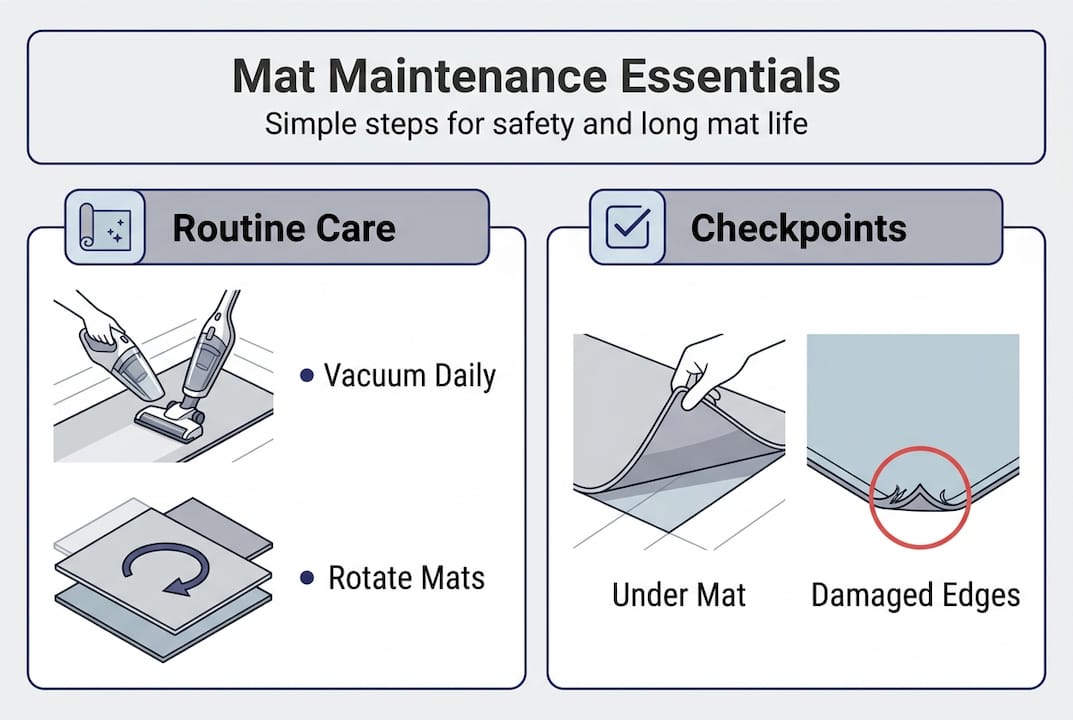
- Daily: Vacuum or shake out mats in high-traffic zones. Spot clean spills immediately.
- Daily: Inspect mat edges and surface for visible hazards or debris buildup.
- Weekly: Perform wet cleaning using appropriate solutions for each mat type.
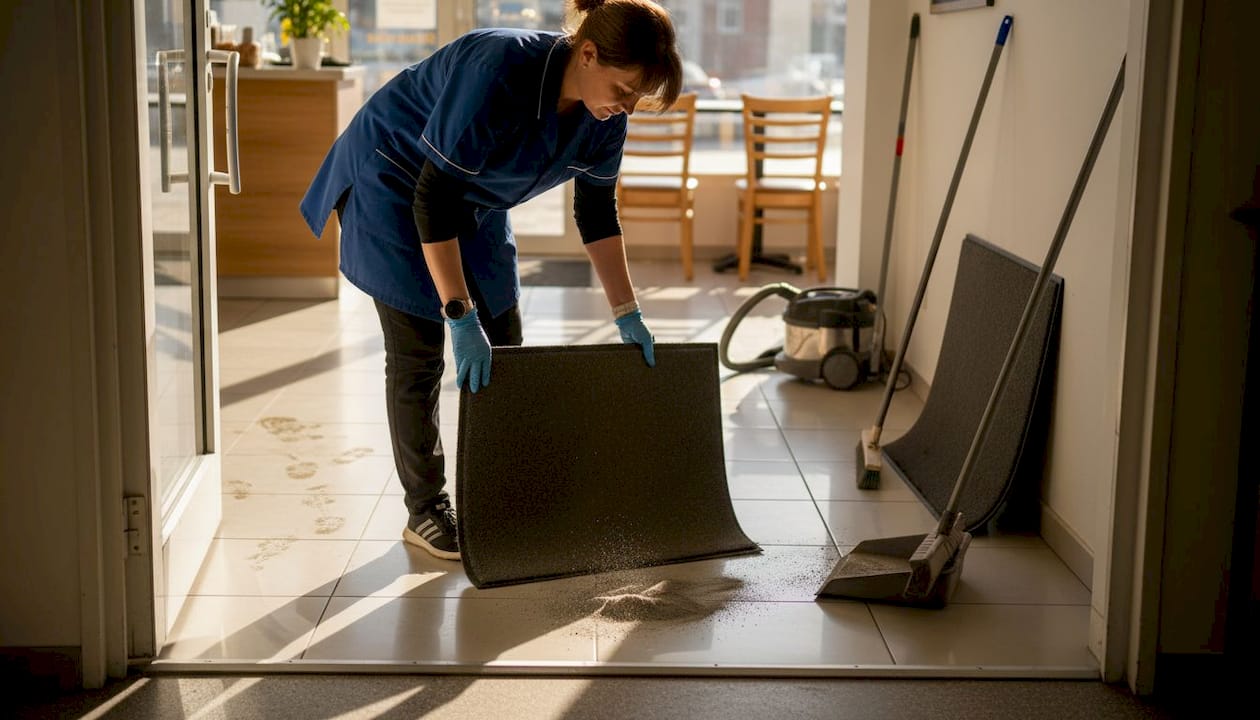
- Weekly: Lift mats and clean the floor underneath before replacing them.
- Weekly: Allow mats to air dry fully before returning them to service.
- Weekly: Rotate mats from high-traffic to lower-traffic positions to even out wear.
Daily vacuuming prevents dirt embedding in high-traffic areas, which is the single most effective daily action you can take. Skipping even two or three days allows grit to work into mat fibers like an abrasive, cutting fiber life significantly.
The floor underneath the mat is just as important. Trapped dirt acts like sandpaper on hard floor surfaces, scratching finishes and creating uneven surfaces that shift mat positioning. Cleaning underneath weekly protects both the mat and the floor investment.
Traffic level comparison:
| Traffic level | Vacuum frequency | Wet clean frequency |
|---|---|---|
| High (500+ daily entries) | Daily | Weekly |
| Medium (100-500 entries) | 3x per week | Bi-weekly |
| Low (under 100 entries) | Weekly | Monthly |
Mats capture more than 80% of tracked-in dirt when properly maintained, which directly reduces floor cleaning costs and extends floor finish life. That stat alone justifies the time investment in a consistent routine.
Pro Tip: Keep at least one backup mat per entry point in your supply room. Rotating mats during deep cleaning cycles means you never leave a bare floor exposed. Review the commercial floor mat cleaning guide for detailed rotation strategies, and consult a floor mat cleaning service guide if you are considering outsourcing periodic deep cleans.
Special care for different mat types
Not all mats require the same approach. Let’s break down key differences by mat type.
Rubber and scraper mats:
- Hose off loose debris before applying any cleaner
- Use mild soap or a pH-neutral solution with a stiff brush
- Avoid petroleum-based cleaners, which cause rubber to swell and crack
- Rinse thoroughly and air dry flat before reinstalling
- For detailed guidance, see cleaning rubber floor surfaces
Carpeted and Berber mats:
- Vacuum thoroughly before any wet cleaning
- Use a wet extractor for deep cleaning, not a standard mop
- Never use bleach, as it breaks down fiber bonding and causes rapid fraying
- Test any carpet cleaning solution on a small area first
Anti-fatigue mats:
- Wipe down daily with a damp cloth and mild dish soap
- Avoid soaking, as prolonged moisture exposure can compromise foam core integrity
- Inspect the surface for cuts or tears that reduce cushioning effectiveness
For rubber and scraper mats, hose off first, apply mild soap, and avoid petroleum products entirely. For carpeted mats, vacuum and extract without bleach. Always test chemicals on a small area before full application.
Safety note: Always air dry mats completely after wet cleaning. A mat returned to service while still damp promotes mold and mildew growth, creates slip hazards on the floor surface underneath, and can trap moisture that damages floor finishes. Full drying is not optional.
For facilities with rubber flooring systems, the principles extend beyond individual mats. The rubber flooring longevity and safety resource covers how mat care integrates with broader floor maintenance programs.
Inspection, rotation, and replacement strategies
Good routines are strongest when paired with smart monitoring and timely action. Cleaning a mat that is structurally compromised does not restore its safety function.
Quarterly inspection checklist:
- Check all mat edges for curling or lifting. Curled edges are a direct trip hazard.
- Inspect the surface for thinning, fraying, or fiber loss.
- Flip the mat and examine the backing for delamination or separation.
- Test mat stability on the floor. Mats that slide indicate worn backing.
- Document findings in a maintenance log with date and mat location.
Inspect quarterly for fraying, thinning, and curling. Replace any mat where edges curl upward or backing has separated from the surface layer. These are not cosmetic issues. They are liability risks.
Signs a mat must be replaced immediately:
- Edges that curl more than half an inch off the floor
- Visible backing separation or delamination
- Surface fibers worn flat with no texture remaining
- Persistent odor after cleaning, indicating embedded mold
- Structural tears or holes in the mat body
Rotation extends mat life significantly. Move mats from the highest-traffic entry points to secondary locations periodically, and bring secondary mats to primary positions. Layered matting systems, where a scraper mat sits outside and a wiper mat sits inside, distribute wear across multiple products rather than concentrating it on one.
Proper maintenance can extend mat life from 12 to 18 months up to 2 to 5 years depending on traffic volume. That is a significant return on a modest time investment. Use the when to replace mats guide to set replacement thresholds, and review avoid slippery floor accidents for complementary safety strategies.
Mat maintenance: What most guides miss
Having covered routines and replacement, let’s explore what sets truly effective mat maintenance apart. Most guides focus on cleaning frequency and chemical selection. Those matter. But the facilities that consistently maintain safe, long-lasting mats do something different: they treat mat maintenance as a system, not a task.
The biggest gap we see is coverage continuity. When a mat goes out for deep cleaning, the floor underneath is exposed. Without a backup mat in place, that gap creates an immediate hazard. High-traffic facilities should carry at least two mats per primary entry point in inventory at all times.
The second gap is accountability. Verbal instructions to cleaning staff are forgotten. Written logs and inspection checklists are not. A simple dated log showing who cleaned what mat, when, and what condition it was in creates a record that protects both the facility and the staff. It also surfaces patterns, like a mat that keeps curling despite regular cleaning, that signal a product fit issue rather than a maintenance failure.
Finally, communication between cleaning crews and facility managers is often missing. Cleaning staff see mat conditions daily. Managers make replacement decisions. When those two groups do not share information, hazardous mats stay in service longer than they should. Review mat cleaning challenges for practical ways to close that communication gap.
Find mats and solutions for every facility
To put these practices to work, you need quality mats and support. The right mat for your facility depends on traffic volume, entry type, and floor surface. At Mats4U, you’ll find a full range of commercial and industrial options built to withstand demanding environments.
For entry points with heavy moisture and dirt load, the WaterHog Max Diamond Mat delivers superior scraping and water retention. For workstations where staff stand for extended periods, the Comfort Premier mat provides durable anti-fatigue support. All products ship free on orders over $100, and the full catalog of matting solutions includes custom sizing and logo options for branded facilities.
Frequently asked questions
How often should I clean commercial mats in high-traffic areas?
Mats in high-traffic areas should be vacuumed or spot cleaned daily and wet cleaned weekly to prevent dirt from embedding into fibers and degrading mat performance.
What cleaning chemicals should I avoid for mats?
Avoid bleach, petroleum solvents, and harsh alkaline cleaners. These degrade rubber backing and significantly shorten mat lifespan regardless of mat type.
How can I tell when a mat needs to be replaced?
Replace mats that show curled edges, fraying, or delamination immediately, as these conditions create direct trip and slip hazards in your facility.
Why is air drying mats important?
Fully drying mats after wet cleaning prevents mold and slip hazards and protects the floor surface underneath from moisture damage.
How much longer do mats last with proper care?
Well-maintained mats last 2 to 5 years compared to just 12 to 18 months when maintenance is inconsistent or neglected.


