


TL;DR:
- Slip and fall prevention in kitchens requires a combination of mats, footwear, and cleaning protocols.
- Rubber mats with drainage patterns and proper DCOF ratings are essential for safety compliance.
- Regular inspection and maintenance are critical to ensure mats remain effective and reduce injury claims.
Slip-and-fall injuries rank among the most costly incidents in commercial kitchens, and the right mat is only part of the answer. Anti-fatigue properties reduce fatigue by up to 25%, which means the mats under your staff’s feet directly affect both safety and productivity. But choosing a mat without understanding the full risk environment leaves serious gaps in your safety program. This guide covers how to select, maintain, and optimize non-slip kitchen mats so your facility meets compliance standards and keeps your team safer every shift.
Table of Contents
- Understanding slip risks in commercial kitchens
- Key features of effective non-slip kitchen mats
- Industry standards and compliance in mat selection
- Maximizing mat effectiveness: Cleaning, maintenance, and integration
- Our take: What most kitchen safety guides miss
- Find the right mat for your kitchen safety needs
- Frequently asked questions
Key Takeaways
| Point | Details |
|---|---|
| Multi-factor safety | Non-slip mats are most effective when paired with proper footwear and cleaning routines. |
| Optimal mat specs | Commercial kitchens should use mats 0.75-1 inch thick with high slip resistance for best results. |
| Compliance matters | Choosing mats certified to meet industry standards reduces workplace slip claims and legal risks. |
| Integrated maintenance | Regular cleaning and routine inspections are essential to maintain mat performance and safety. |
Understanding slip risks in commercial kitchens
Commercial kitchens are among the most slip-prone environments in any industry. Grease migrates across floors faster than most cleaning cycles can manage. Water pools near dish stations, ice machines, and prep sinks. Staff move quickly, often carrying heavy loads, and footwear varies widely in quality. None of these factors operates in isolation, and that combination is what makes kitchen slip risk so difficult to control with a single solution.
The common slip contributors in a busy kitchen include:
- Grease and oil residue from cooking surfaces and fryers
- Standing water near sinks, dishwashers, and ice machines
- Worn or inadequate footwear that lacks slip-resistant outsoles
- Inconsistent cleaning schedules that allow buildup between shifts
- Mat edges that curl, buckle, or shift and become trip hazards themselves
Mats address several of these issues, but they do not address all of them. This is a critical distinction for facility managers.
“Comprehensive slip-and-fall prevention programs that combine mats, footwear, and housekeeping protocols show the strongest results in reducing workplace injury claims.”
Hospital claim reduction studies confirm that facilities relying on mats alone see far weaker outcomes than those running integrated programs. The CDC/NIOSH guidance is direct: mats alone are insufficient without pairing them with slip-resistant footwear, proper cleaning, and active housekeeping.
For a practical starting point, the non-slip floor guide breaks down floor surface interactions that affect mat performance. Understanding the floor beneath the mat matters as much as the mat itself. The safety and compliance benefits of a properly deployed mat program go well beyond simple fall prevention, including reduced insurance liability and improved worker retention. When you start preventing injuries at the source, the operational cost savings are measurable and consistent.
The takeaway: treat your mat program as one layer in a multi-layer safety system, not as the system itself.
Key features of effective non-slip kitchen mats
Not all mats perform equally under commercial kitchen conditions. Selecting the wrong product, even a well-reviewed one, can create new hazards instead of eliminating them.
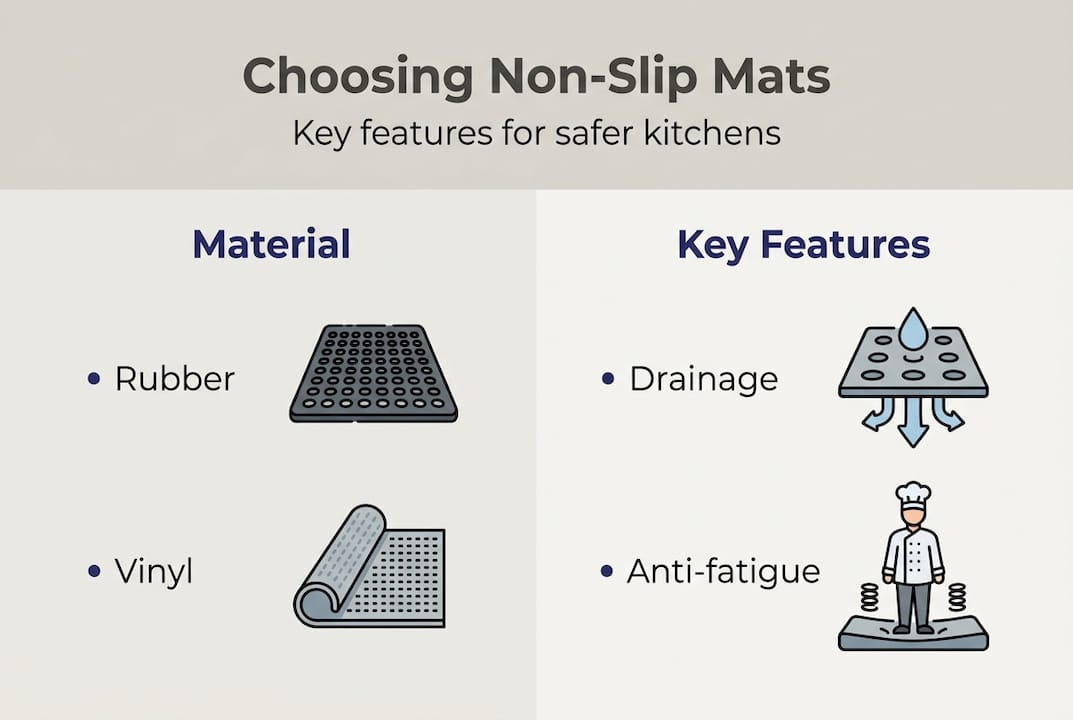
Material is the first decision point. Rubber mats dominate commercial kitchens for good reason. They resist grease degradation, hold up under heavy cleaning chemicals, and maintain grip over time. PVC mats cost less upfront but can become brittle or slick when exposed to repeated high-temperature cleaning. For most facility managers, rubber is the more reliable long-term investment.
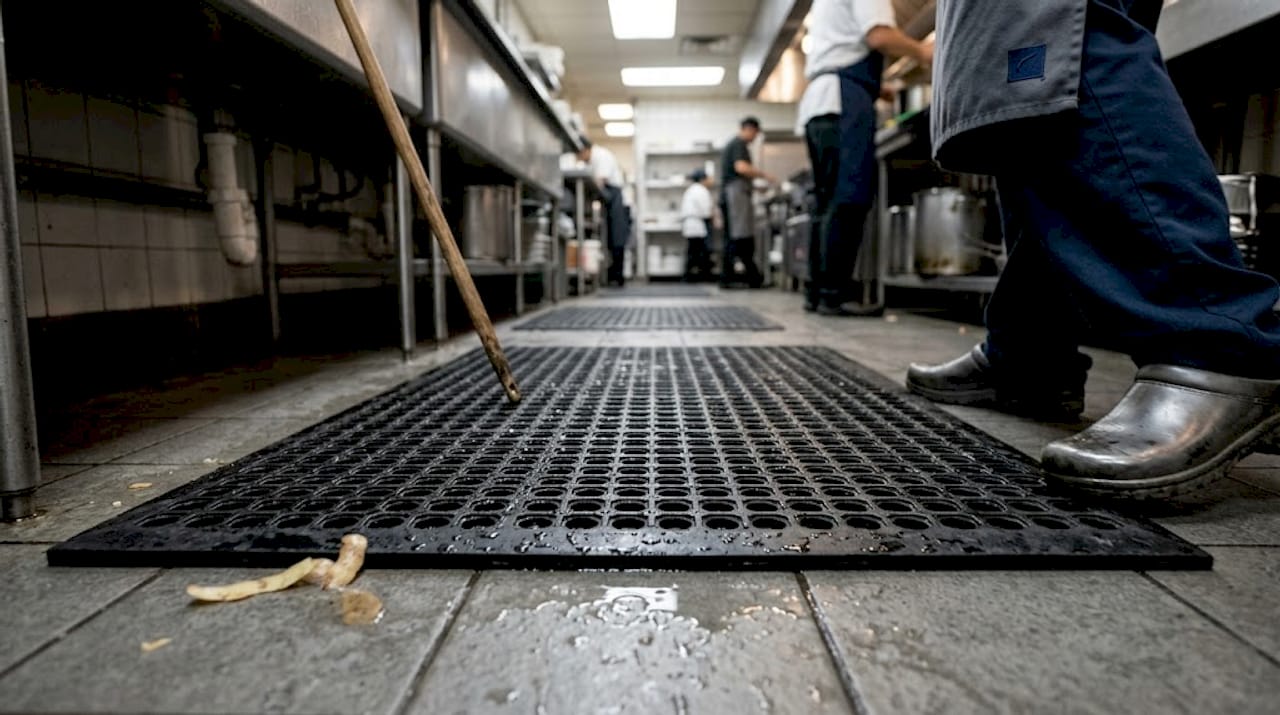
Surface design determines grip performance. Open-grid or drainage patterns allow liquids and grease to pass through the mat surface rather than pool on top. This keeps the standing surface drier and significantly improves traction. Flat-surface mats, regardless of material, trap liquid on top and reduce effective slip resistance.
Thickness directly affects anti-fatigue performance. Optimal commercial thickness is 0.75 to 1 inch, which provides enough cushion to reduce leg and back fatigue during long shifts without creating unstable footing. Mats thinner than this wear out faster and deliver minimal ergonomic benefit.
Slip resistance ratings are measured using the Dynamic Coefficient of Friction (DCOF). Commercial kitchens require a DCOF of 0.55 to 0.65 in areas exposed to grease and oils, which is significantly higher than residential standards. Always verify DCOF ratings before purchasing.
| Mat type | Material | Drainage | Anti-fatigue | DCOF suitability |
|---|---|---|---|---|
| Open-grid rubber | Rubber | Yes | Moderate | High |
| Closed-surface rubber | Rubber | No | High | Moderate |
| PVC drainage mat | PVC | Yes | Low | Moderate |
| Anti-fatigue foam mat | Foam/vinyl | No | High | Low |
Pro Tip: Place mats at every transition point, not just at the primary work stations. Entry points, dishwashing stations, and walk-in cooler exits are high-risk zones that often get overlooked.
The guide to choosing kitchen mats details how to match mat specs to specific kitchen zones. For a curated selection of products already vetted for commercial use, the best mat options page offers a practical reference.
Industry standards and compliance in mat selection
Buying a mat with the right features is not enough if it does not meet the standards your facility is required to follow. Compliance protects your staff and your business.
DCOF is the most relevant metric for commercial kitchen applications. Unlike Static Coefficient of Friction (SCOF), which measures resistance to slipping while stationary, DCOF measures resistance during actual movement. Static vs. dynamic COF are not interchangeable, and facilities that rely on SCOF ratings for dynamic kitchen environments are using the wrong benchmark. Always confirm DCOF values.
| Standard | Requirement | Applies to |
|---|---|---|
| DCOF minimum | 0.42 (general) | All commercial floors |
| DCOF for kitchens | 0.55 to 0.65 | Grease-exposed areas |
| ANSI A137.1 | Wet DCOF testing | Tile and mat surfaces |
| NSF certification | Sanitation compliance | Food-service environments |
Compliance steps for facility managers:
- Request DCOF test data from mat suppliers before purchasing
- Confirm NSF certification for any mat used in food prep or service areas
- Verify that mat dimensions cover all required zones without creating curled edges
- Document mat installation dates and schedule replacement before wear degrades performance
- Review mat compliance annually or after any facility inspection
Facilities that follow structured compliance programs report significant slip claim reductions, with compliant kitchens showing over 50% fewer slip-related incidents compared to non-compliant operations. That is not a marginal improvement; it represents a fundamental shift in risk exposure.
The waterproof mat guide provides additional detail on how waterproofing ratings interact with DCOF performance in wet kitchen zones. For a broader view of how compliance reduces operational risk, the compliance benefits overview covers liability, insurance, and inspection outcomes in practical terms.
Maximizing mat effectiveness: Cleaning, maintenance, and integration
A compliant, well-specified mat will still fail if it is not maintained correctly. Grease and debris accumulate quickly in commercial kitchens, and a mat clogged with residue loses its drainage function and grip performance.
Top maintenance practices for commercial kitchen mats:
- Daily cleaning: Rinse mats with hot water and degreaser at the end of each shift
- Weekly deep cleaning: Use a pressure washer or dedicated mat cleaning equipment to remove embedded grease
- Inspection schedule: Check for curling edges, tears, or surface degradation every week
- Rotation protocol: Rotate mats across positions to distribute wear evenly
- Replacement triggers: Replace mats when surface texture is visibly worn or grip testing shows DCOF drop
Pro Tip: Implement a two-step mopping protocol on kitchen floors before repositioning mats. First mop with a degreaser, then mop with clean water. This prevents residue from being trapped under the mat, which would otherwise reduce grip from below.
Cleaning practices and mat performance are directly linked. Mats combined with proper cleaning and slip-resistant footwear consistently outperform isolated mat programs in workplace safety studies. The cleaning process matters as much as the mat specification itself.
Steps to integrate mats with your broader safety program:
- Train staff on mat placement rules and reporting damaged mats immediately
- Pair mat deployment with a facility-wide slip-resistant footwear policy
- Assign daily mat inspection to shift supervisors, not just cleaning staff
- Log all mat-related incidents and near-misses to identify placement gaps
- Use mat maintenance tips to build a recurring maintenance calendar
The mat cleaning guide and effective mat cleaning resources provide step-by-step protocols tailored to commercial operations, which removes the guesswork from daily routines.
Our take: What most kitchen safety guides miss
Most kitchen safety content focuses on mat type selection and stops there. That misses the bigger issue. Facilities that reduce slip incidents most effectively are not the ones with the most expensive mats. They are the ones treating mat deployment as a managed program, not a one-time purchase.
The uncomfortable reality is that mats alone do not cut risks without the surrounding protocols. Staff training, cleaning schedules, and footwear policies have to run in parallel. A worn-out mat that has never been inspected is worse than no mat at all because it creates a false sense of compliance.
We also see facilities skip quarterly audits entirely. Auditing your mat implementation every quarter, checking placement, condition, and DCOF validity, catches degradation before it becomes a liability. Review your safety benefits program as a system, and audit it accordingly. The mat is the starting point, not the finish line.
Find the right mat for your kitchen safety needs
With the fundamentals of slip risk, mat features, compliance standards, and maintenance now clear, the next step is selecting products built to meet those requirements. Mats4U carries commercial-grade options designed specifically for high-traffic kitchen environments, from anti-fatigue mat solutions that support staff through long shifts to custom logo mats that reinforce brand identity at entry points. Every product is sourced for durability, compliance, and real-world kitchen performance. Free delivery applies on orders over $100, and Made in the USA options are available across core categories. Browse the full range at Mats4U.com and match the right mat to every zone in your facility.
Frequently asked questions
What thickness is ideal for anti-fatigue kitchen mats?
Commercial kitchens benefit from mats that are 0.75 to 1 inch thick, which delivers the right balance of cushioning and stability for prolonged standing during full shifts.
How does DCOF affect mat selection for commercial kitchens?
A DCOF of 0.55 to 0.65 is required in grease-exposed kitchen areas; values below this threshold do not provide adequate slip resistance under real working conditions.
Are mats alone enough to prevent slips and falls in kitchens?
No. Mats paired with footwear and proper cleaning protocols consistently outperform mat-only approaches, which is why integrated programs are the accepted safety standard.
How often should commercial kitchen mats be cleaned?
Mats should be rinsed and degreased daily and deep cleaned weekly to preserve drainage function, grip performance, and overall hygiene in food-service environments.
What practical steps can facility managers take to improve mat effectiveness?
Integrate mats with cleaning protocols, conduct quarterly inspections, enforce footwear policies, and train staff to report mat damage immediately for the strongest safety outcomes.
Recommended
- Best Non Slip Kitchen Mats: Ensuring Commercial Safety – Mats4U USA
- Non Slip Kitchen Floor Mats: Safer Workspaces, Lower Risks – Mats4U USA
- Non Slip Kitchen Rugs – Boosting Safety in Busy Workspaces – Mats4U USA
- 7 Best Commercial Kitchen Mats for Safety and Comfort – Mats4U USA
- Designing handrails for safety and style: A guide for interiors – Inoxify


