


TL;DR:
- Many workplace injuries from slips and falls are caused by flooring issues that facility managers often overlook. Properly selected and maintained office safety mats, such as anti-slip, anti-fatigue, and chair mats, significantly improve fall prevention, reduce fatigue, and protect floors. Using standards-based testing like ASTM E303 ensures effective slip resistance, and integrating mats into a comprehensive safety program maximizes their benefits.
Slips, trips, and falls account for a significant share of workplace injuries every year, and most facility managers underestimate how much flooring plays a role. Office safety improvement mats are not a cosmetic addition to your floor plan. They are a frontline intervention that addresses fall prevention, standing fatigue, chair mobility, and contamination control in one product category. This guide walks you through how to select, test, and deploy the right mats for your specific environment, using evidence-based criteria that go beyond simply picking a mat that looks right.
Table of Contents
- Key takeaways
- Office safety improvement mats: types and core benefits
- Safety standards and testing methods for mat selection
- Ergonomic and health benefits of anti-fatigue mats
- Practical considerations for mat selection and maintenance
- Applying mat solutions: practical deployment steps
- My take on mats as an underused safety tool
- Upgrade your office safety with Mats4u
- FAQ
Key takeaways
| Point | Details |
|---|---|
| Mat type determines safety function | Anti-slip, anti-fatigue, and chair mats each solve different safety problems and should not be interchanged. |
| ASTM standards guide selection | Dynamic friction testing (ASTM E303) is the most reliable predictor of real-world slip resistance performance. |
| Ergonomic mats reduce injury costs | Anti-fatigue mats reduce muscle strain and discomfort for employees who stand for extended periods. |
| Maintenance preserves performance | Regular inspection and cleaning are required to retain slip resistance and prevent contamination spread. |
| Mats work best in a system | Combining mats with proper footwear, signage, and training produces the most measurable safety outcomes. |
Office safety improvement mats: types and core benefits
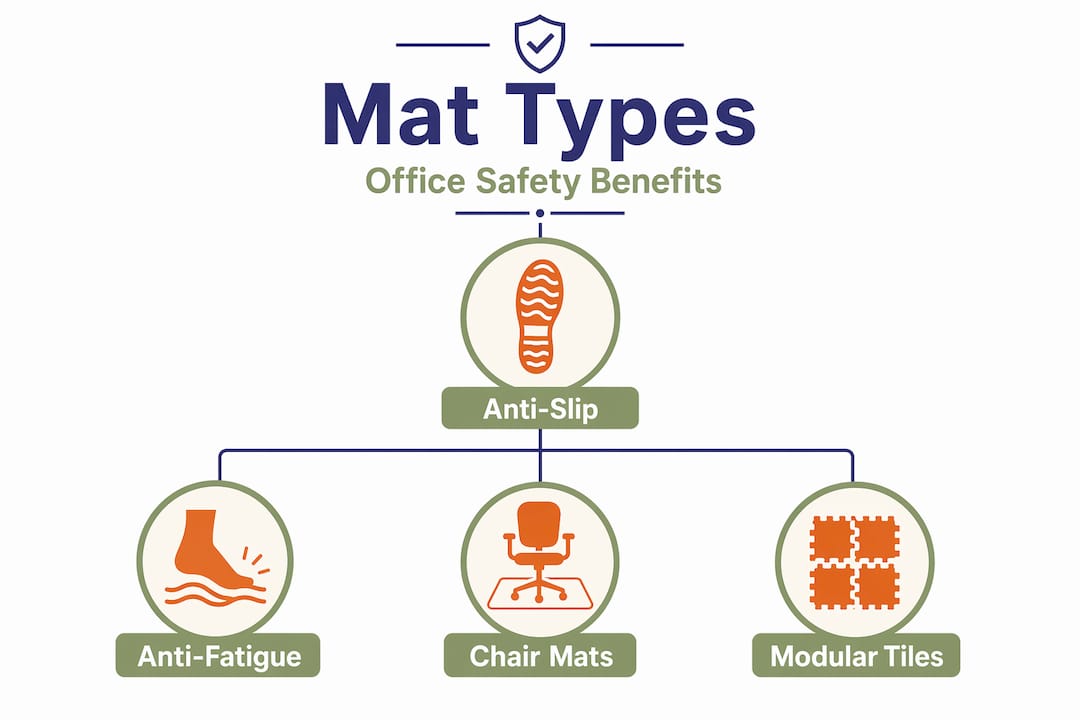
Not every mat on the market is built for the same job. Understanding the three primary categories gives you a working framework for specifying mats across different zones in your facility.
Anti-slip mats are the most direct tool for fall prevention. Their primary function is traction. Placed in high-risk zones such as building entrances, break rooms, restrooms, and areas near water coolers or coffee stations, these mats create a stable surface on floors that would otherwise become dangerous when wet. Nitrile rubber mats provide reliable non-slip profiles specifically engineered for contaminated surfaces, and their material composition resists degradation from cleaning chemicals.
Anti-fatigue office mats address a different risk entirely. These mats reduce the physical toll of prolonged standing, which is increasingly common in office environments with standing desks and reception stations. They work by promoting subtle foot and leg movements that keep circulation active, which directly reduces the static load on joints and the spine.
Chair mats complete the picture. Beyond protecting carpet and hard flooring from caster damage, modern chair mats in polycarbonate, PVC, bamboo, and eco-friendly materials reduce trip hazards created by bunched carpet or uneven wear patterns under desk areas.
Here is a quick reference for matching mat type to office application:
| Mat type | Primary safety function | Common office location |
|---|---|---|
| Anti-slip mat | Fall prevention on wet or contaminated surfaces | Entrances, kitchens, restrooms |
| Anti-fatigue mat | Reduces fatigue and musculoskeletal strain | Standing desks, reception, assembly |
| Chair mat | Floor protection, caster stability, trip prevention | Under desk workstations |
Key considerations when selecting across these categories:
- Surface compatibility: rubber-backed mats on hard floors, carpet-gripping mats on soft floors
- Traffic volume: heavier foot traffic requires thicker, more durable materials
- Moisture exposure: drainage mats or waterproof materials in wet zones
- Visibility: high-contrast borders reduce trip hazards at mat edges
Safety standards and testing methods for mat selection
This is where most facility managers make their biggest mistake. They purchase mats based on product descriptions that reference “slip-resistant” without verifying what that claim actually means. Slip resistance is not a single measurement. How it is measured changes whether the number is useful to you or not.
The field has moved decisively toward dynamic friction testing. ASTM F2913 redirected industry focus away from static coefficient of friction testing toward dynamic friction methods that better reflect how slips actually occur during walking. Static testing measures resistance before movement begins. Dynamic testing measures what happens during the slip event itself, which is far more relevant for pedestrian safety.
The pendulum test (ASTM E303) is the most reliable method for assessing real-world slip risk in environments where mats are deployed. It simulates a heel strike on a wet surface and produces a Pendulum Test Value (PTV) that correlates with actual injury data from pedestrian falls.
Why does this matter for your purchasing decisions?
- Request dynamic friction test data, not just a label claiming “slip-resistant”
- Ask manufacturers whether their products were tested wet, not only dry
- Compare PTV values across products when evaluating entrance and wet-area mats
- Verify that testing was conducted on surfaces similar to your flooring type
Pro Tip: Ask your mat supplier for the specific ASTM test report for each product, not just a general compliance statement. A PTV of 36 or above is widely referenced as the threshold for low slip risk in wet pedestrian conditions. If a supplier cannot provide this data, that tells you something important about the product.
Compliance with recognized standards also matters from a liability standpoint. If an employee slips and your mat selection cannot be defended by reference to objective test data, your organization faces greater exposure. Documented, standards-based purchasing is part of a defensible workplace safety program.
Ergonomic and health benefits of anti-fatigue mats
Anti-fatigue office mats do more than make standing more comfortable. They function as a subtle intervention against musculoskeletal disorders, which are among the most costly and common categories of workplace injury. The mechanism is specific. A mat with the right compression properties encourages micro-movements in the feet and lower legs, which pumps blood back toward the core and reduces pooling in the lower extremities.
Studies confirm that these mats reduce leg heaviness, joint strain, and back discomfort for workers who stand for extended periods. In office environments, this applies to:
- Reception and front-desk staff who stand through most of a shift
- Employees using height-adjustable standing desks for two or more hours at a time
- Mailroom and copy room workers with primarily standing job tasks
- Retail-adjacent roles within corporate settings, such as showroom staff
The mat itself functions like a training surface, distributing pressure more evenly across the foot and reducing localized stress on the heel, knee, and lower spine. This is not a minor quality-of-life upgrade. Musculoskeletal complaints drive sick days, reduced productivity, and workers’ compensation claims.
Material selection determines how well an anti-fatigue mat performs over time. Closed-cell foam loses compression under heavy use and should be evaluated for higher-traffic zones. Rubber anti-fatigue mats handle heavier loads and are easier to sanitize, making them better suited for multi-user environments. Gel-foam combinations offer the strongest pressure distribution for single-user standing desk applications.
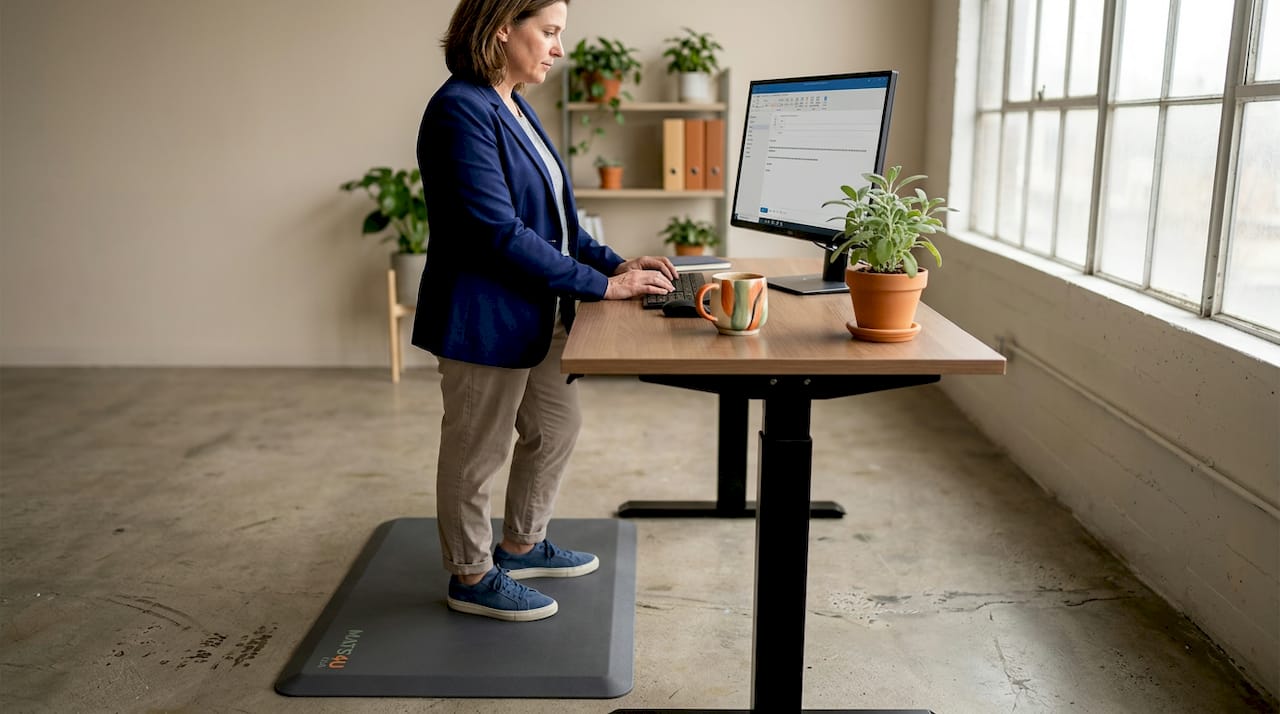
Pro Tip: For standing desk users, specify a mat with a minimum thickness of 3/4 inch and a beveled edge profile. Thin mats lose compression within weeks under concentrated standing loads, and square edges become trip hazards as mats curl over time.
Connecting anti-fatigue mat use to measurable outcomes makes the business case to budget holders. Track complaint rates, sick day frequency, and productivity metrics before and after mat installation in target areas.
Practical considerations for mat selection and maintenance
Selecting the right mat is only half the job. A high-performance mat installed incorrectly or maintained poorly will fail faster and may introduce new hazards. Here is a structured approach to getting this right:
- Assess floor type first. Carpet, polished tile, hardwood, and poured concrete all behave differently. A mat with a rubber backing designed for hard floors will shift on carpet, creating a trip hazard. Match backing material to the substrate explicitly.
- Calculate foot traffic volume. Light-traffic mats placed in high-traffic corridors compress and curl within weeks. Use manufacturer-stated traffic ratings as a minimum specification, not a target.
- Establish a cleaning schedule. Regular cleaning and inspection prevent hazardous material buildup on mat surfaces and preserve the slip-resistant properties that made the mat worth purchasing. A mat clogged with dirt, oil, or cleaning residue loses traction.
- Inspect edges and backing regularly. Curled edges and detached backing are trip hazards. Set a documented inspection interval, monthly at minimum, and replace mats that show edge lifting or backing separation.
- Factor in replacement cycles. Material choice directly affects durability and the frequency of replacement. Rubber mats in busy areas may last three to five years. Lower-cost foam mats in the same zones may require replacement within six months.
Integrating mat selection into your broader workplace safety program means documenting which mats are deployed where, when they were installed, and what the replacement trigger conditions are. That documentation supports both safety audits and insurance reviews.
The office mat market is shifting toward modular and recyclable materials, which can simplify replacement logistics in larger facilities. Mats with recycled content are increasingly available without sacrificing performance specifications.
Applying mat solutions: practical deployment steps
Theory translates to results only when implementation is deliberate. When deploying office safety improvement mats across a facility, use this framework:
- Conduct a zone audit. Walk the facility and categorize each area by slip risk, standing duration, and floor type. Map your current mat coverage against these findings.
- Prioritize high-risk areas first. Entrances, kitchens, restrooms, and any area with regular wet-floor conditions should receive anti-slip mats before other zones are addressed.
- Combine mats with supporting measures. As part of a holistic safety approach, mats work best alongside appropriate footwear policies, wet-floor signage, and regular employee awareness reminders. No mat fully compensates for worn-out shoes or ignored spill protocols.
- Document your baseline. Record incident reports, near-miss logs, and comfort complaints before mat installation. Revisit this data at six months and twelve months to measure outcomes.
- Set a review schedule. Facility layouts change. New standing desks get added. Traffic patterns shift. Review your mat strategy annually to keep coverage current.
Tracking outcomes over time also gives you the data needed to justify continued or expanded mat investment to senior leadership.
My take on mats as an underused safety tool
I’ve reviewed a lot of workplace safety programs, and mats are consistently the most underfunded and least strategically managed part of the floor safety picture. Facilities that spend significant resources on PPE and training often have entrance mats that are five years old, curled at the edges, and genuinely more dangerous than the bare floor they replaced.
The other pattern I see regularly: anti-fatigue mats purchased for ergonomic reasons, but specified without regard for compression rating or thickness. A mat that feels cushy on day one but bottoms out within three months has delivered exactly zero long-term benefit. The purchase was made, the box was checked, and the problem was not solved.
What I’ve learned from tracking safety program outcomes is that mat selection rewards specificity. The facility managers who get the best results treat mats like they treat any other safety equipment: with documented specs, defined replacement schedules, and outcome tracking. They ask for test data. They match material to environment. They inspect regularly.
The shift to hybrid work and height-adjustable desks has also changed the mat equation in ways many facilities have not caught up with yet. Standing desk usage has increased the demand for high-quality anti-fatigue solutions in areas that previously only needed chair mats. If your mat strategy was written before standing desks became standard in your facility, it needs a revision.
Mats are not glamorous. They do not generate the enthusiasm that a new safety training platform does. But their impact on slip injuries, fatigue-related errors, and musculoskeletal complaints is direct and measurable. Treat them accordingly.
— Werner
Upgrade your office safety with Mats4u
Mats4u stocks a purpose-built range of commercial floor mats designed for the specific demands facility and safety managers face. For standing workstations and reception areas, the Cushion Select Mat delivers durable anti-fatigue performance rated for industrial use, and it holds up in high-traffic office environments just as well. The Comfort Premier Mat is a top-rated ergonomic option for extended standing shifts, combining hygienic construction with proven pressure distribution. For building entrances, WaterHog mats combine aggressive slip resistance with water and dirt containment, cutting down on the contamination that makes interior floors dangerous. All products ship free on orders over $100, and Mats4u carries Made in the USA options across key categories.
FAQ
What are office safety improvement mats used for?
Office safety improvement mats prevent slips, reduce standing fatigue, and protect flooring from damage. Different mat types address specific hazards including wet-floor falls, musculoskeletal strain from prolonged standing, and trip risks from uneven flooring under desk areas.
How do anti-fatigue mats improve workplace safety?
Anti-fatigue office mats promote micro-movements in the feet and legs that maintain circulation and reduce joint strain during prolonged standing. Research shows they measurably reduce leg heaviness, back discomfort, and fatigue that can lead to errors and injuries.
What slip resistance standard should I look for in office mats?
Look for products tested using dynamic friction methods, specifically ASTM E303 pendulum testing. A Pendulum Test Value of 36 or above is the widely referenced low-risk threshold for wet pedestrian surfaces. Avoid relying on generic “slip-resistant” labels without accompanying test data.
How often should office mats be replaced?
Replacement frequency depends on material and traffic volume. Rubber mats in high-traffic areas typically last three to five years. Foam-based mats in the same conditions may require replacement within six months. Inspect all mats monthly for edge curling, backing separation, and compression loss.
Can mats alone reduce workplace slip-and-fall incidents?
Mats significantly reduce slip risk, but maximum results come from combining mats with proper footwear policies, spill response protocols, wet-floor signage, and employee training. A mat deployed in isolation without supporting safety practices will not capture its full injury-prevention potential.


