


TL;DR:
- Most facility managers overlook entrance mats, underestimating their role in contamination control, safety, and cost savings. Proper multi-layer systems significantly reduce dirt, moisture, and allergens, lowering cleaning, repair, and liability expenses. Implementing large, well-maintained mats enhances building cleanliness, occupant safety, and long-term facility performance.
Most facility managers treat entrance mats as an afterthought, a basic item ordered once and forgotten. That’s a costly mistake. The entrance mat benefits in commercial settings extend well beyond keeping floors tidy. Research shows that 30% to 40% of contaminants tracked inside a building arrive on the soles of shoes, making your building entrance the single most impactful point for contamination control. This guide breaks down how the right mat system improves cleanliness, reduces slip-and-fall liability, and lowers your long-term maintenance costs.
Table of Contents
- How entrance mats reduce contaminants and improve cleanliness
- Comparison of commercial entrance mat types and their unique benefits
- Implementing effective entry mat systems for maximum safety and cleanliness
- Maintenance best practices to extend entrance mat life and hygiene
- Summary of entrance mat benefits for facility managers and business owners
- Why many facility managers underestimate entrance mat value — and what they miss
- Explore premium entrance mat solutions to enhance your facility’s safety and cleanliness
- Frequently asked questions
How entrance mats reduce contaminants and improve cleanliness
Every person who walks through your building’s front door carries a layer of outdoor debris on their shoes, soil, moisture, pollen, bacteria, and fine particulate matter. Without a proper entry system, that contamination disperses across your floors within seconds. The advantages of entrance mats at this point are direct and measurable.
Understanding how entrance mats work helps clarify why a single mat rarely does the full job. A multi-layer entry system is the most effective approach. It combines an exterior scraper mat to dislodge coarse debris with an interior absorbent mat to capture moisture and finer particles. This staged approach gives each mat a specific, manageable task rather than expecting one mat to do everything.
The cleanliness impact compounds quickly. Less dirt indoors means less abrasive grit grinding into your flooring surface. Fewer moisture tracks mean shorter drying times and lower slip risk. And for facilities where indoor air quality matters, such as healthcare offices, schools, or food service spaces, reducing tracked-in particles directly lowers allergen and asthma triggers for occupants and staff.
Key contaminants intercepted by a well-designed entry mat system include:
- Soil and fine grit that scratch and degrade hard floor surfaces
- Moisture from rain, snow, and wet conditions
- Pollen and outdoor allergens
- Bacteria and pollutants attached to shoe soles
- Road chemicals and de-icing salts that stain and corrode floors
A building with no entry mat system can require up to 50% more cleaning labor per week compared to one with a properly maintained multi-layer mat setup. The importance of entrance mats becomes clear when you run those numbers over a full year.
Comparison of commercial entrance mat types and their unique benefits
Choosing the right mat type is where most purchasing decisions either succeed or fail. The benefits of door mats vary significantly based on material, construction, and the specific demands of your facility. Here is a direct comparison of the most common commercial options.
| Mat type | Best use case | Key advantages | Limitations |
|---|---|---|---|
| Rubber | Wet environments, heavy foot traffic | Slip resistance, shock absorption, moisture resistant | Can be heavy; less comfortable underfoot long-term |
| Waterhog/Polypropylene | All-weather commercial entrances | High absorbency, durable, easy to clean | Not ideal for decorative applications |
| Wooden | Covered outdoor entries, upscale settings | Eco-friendly, debris falls through slats, low maintenance | Not suited for wet indoor spaces |
| Berber/Carpet fiber | Indoor lobby areas | Soft, absorbs fine particles, appearance-focused | Higher cleaning demand in muddy conditions |
| Anti-fatigue | Standing workstations, service counters | Reduces strain, cushions joints | Not a contamination-control primary tool |
Wooden door mats are durable, eco-friendly, allow debris to fall through slats, and provide low-maintenance protection suitable for high traffic and harsh weather. They work especially well for covered outdoor entries at hotels, restaurants, or upscale office buildings.
Rubber mat flooring reduces slipping, absorbs shock, reduces noise, is moisture resistant, long lasting, and easy to maintain in commercial areas. For any facility dealing with wet weather entries or food and beverage environments, rubber is a strong default choice.
Additional factors to consider when choosing the right entrance mat:
- Foot traffic volume: High-traffic facilities need mats with reinforced edges and durable pile construction that resist matting down over time.
- Environment: Outdoor-facing entries need weather-resistant materials. Indoor-only mats can prioritize absorbency and appearance.
- Maintenance capacity: Lower-maintenance mat materials, such as rubber or wooden slat mats, suit facilities with limited cleaning staff.
- Safety requirements: Slip-resistant backings are non-negotiable for any commercial entry, regardless of mat type.
Pro Tip: When reviewing options in a high traffic entrance mats guide or an industrial matting solutions guide, filter by traffic rating first, then narrow by material based on your environment. Buying a mat rated below your facility’s daily foot count is the most common and expensive mistake.
Implementing effective entry mat systems for maximum safety and cleanliness
A single mat placed casually at the door is not an entry system. It is a placeholder. Effective entrance mat use in commercial facilities requires intentional placement, layering, and integration with your surrounding surfaces.
Follow these steps to build a functional entry mat system:
- Place an exterior scraper mat or grate mat directly at the building entrance. This mat’s job is to remove coarse debris, mud, and gravel from shoe soles before anyone steps inside. Rubber or heavy-duty polypropylene works well here.
- Install a high-absorbency interior mat just inside the door. This mat captures moisture and finer particles that the scraper did not remove. Look for mats with a high pile weight and a water-barrier backing.
- Add a finishing mat in the inner lobby if space allows. This final layer picks up residual contaminants and provides a clean, professional appearance to the space.
- Check slip-resistant backing regularly. Over time, backing can degrade and allow mats to slide, creating a trip and fall hazard rather than preventing one.
- Rotate mats on a regular schedule. Swapping mats between lower-traffic and higher-traffic positions extends the lifespan of your inventory.
- Maintain the surrounding outdoor surface. Cracks, uneven concrete, and standing water near your entrance undermine even the best mat system. Proper concrete sidewalk maintenance is a direct complement to mat performance.
Pro Tip: Size matters more than most people expect. An entry mat should cover at least 6 to 8 feet of walking distance to give shoes enough contact surface. Most facility managers undersize their mats and wonder why performance is disappointing. See a complete breakdown in this guide on entrance matting solutions for high-traffic facilities.
An entry system should consist of an exterior scraper mat and an interior absorbent mat placed just inside the door to capture soil and moisture at shoe level. That is the baseline. Everything above it is an upgrade.
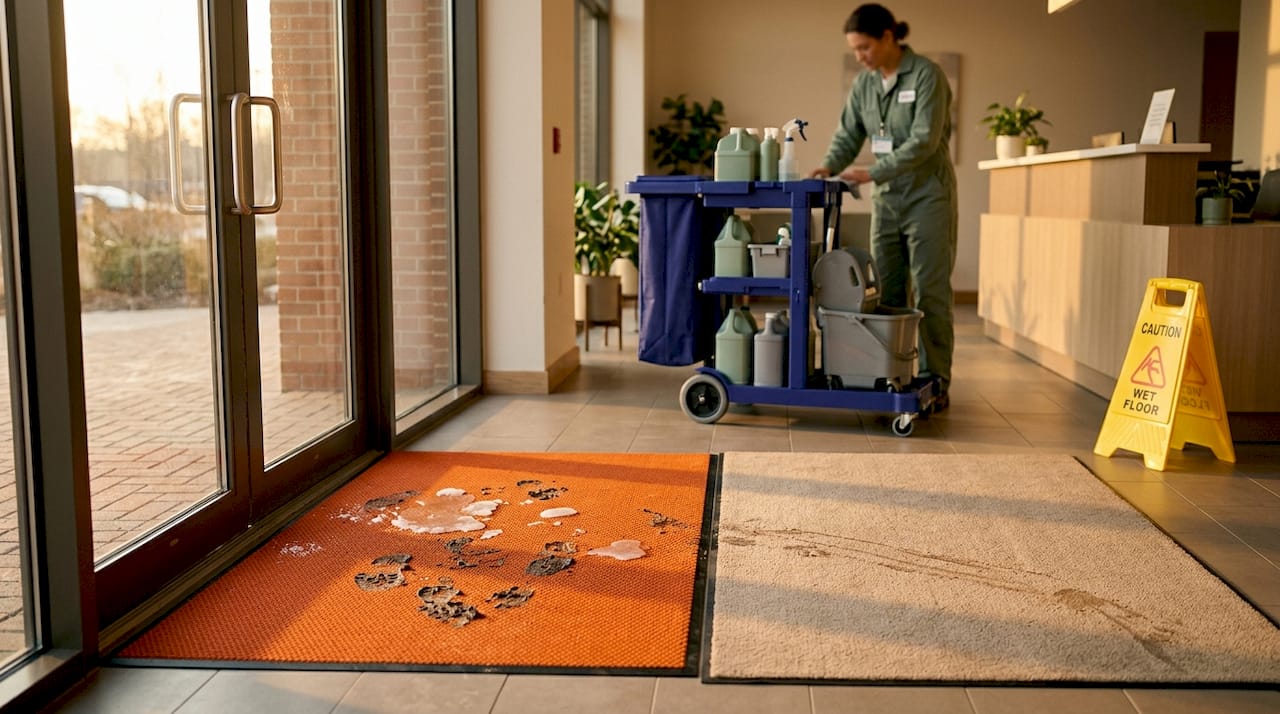
For facilities with specialty requirements, reviewing floor mats entrance advantages by application type helps narrow down the right configuration.
Maintenance best practices to extend entrance mat life and hygiene
A mat that is not cleaned regularly stops performing. Contamination load builds up, absorbency drops, and the mat itself becomes a source of bacteria and allergens rather than a control point. The advantages of doormats only hold when the mats are actually maintained.
Shaking out mats, deep cleaning with detergents and natural agents, and proper drying extend mat life and hygiene. Here is a practical routine for commercial facilities:
- Daily (high-traffic days): Shake out or vacuum the mat to remove loose grit, debris, and hair. This prevents abrasive particles from grinding into mat fibers.
- Weekly: Deep clean with warm water and a mild detergent. For rubber and polypropylene mats, a scrub brush and rinse work well. Baking soda and vinegar are effective natural agents for odor and bacteria control.
- Monthly: Inspect mat edges and backing for wear. Check that slip-resistant backing has not cracked or compressed.
- As needed: Rotate mats between positions to distribute wear evenly and ensure continuous coverage.
Pro Tip: Never run heavy rubber-backed or reinforced commercial mats through a standard washing machine cycle. The agitation and heat damage the backing and reduce the mat’s effective lifespan by more than half. Hand washing or low-pressure hosing is the right method for most commercial mat types.
Air drying is essential. A mat placed back into service while damp creates exactly the kind of mold and mildew environment you are trying to prevent. Allow full drying before reinstalling.
For a complete overview of care by mat type, the commercial entrance mats guide provides material-specific instructions.
Summary of entrance mat benefits for facility managers and business owners
The door mat advantages across a commercial facility add up in ways that are easy to measure when tracked over time. Here is a consolidated view of what quality entrance mats deliver:
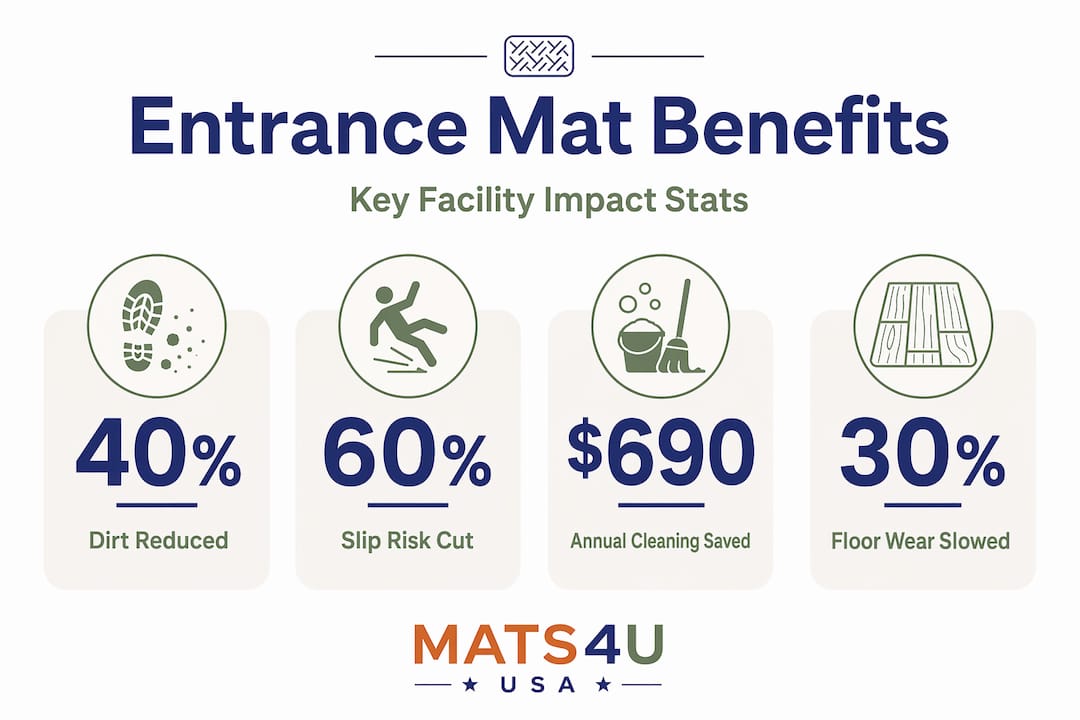
- Contaminant reduction: Entry mats cut contamination by 30% to 40%, directly improving indoor air quality and reducing allergen load for occupants.
- Slip and fall prevention: Slip-resistant backings and moisture-absorbing surfaces reduce floor wetness and the risk of injury claims.
- Floor protection: Trapped grit cannot scratch or abrade your hard flooring surfaces, extending the time between costly floor refinishing or replacement.
- Lower cleaning costs: Less contamination indoors means fewer hours spent mopping, vacuuming, and deep cleaning.
- Environmental benefits: Sustainably sourced mat materials reduce environmental impact without sacrificing performance.
- Occupant comfort: Anti-fatigue mats at entry points and service counters reduce physical strain on staff who stand for extended periods.
| Benefit category | Measurable impact |
|---|---|
| Contaminant control | 30-40% reduction in tracked-in soil and moisture |
| Cleaning cost | Fewer labor hours per week; lower supply spend |
| Floor wear | Extended floor lifespan; delayed refinishing costs |
| Safety liability | Reduced slip incidents; lower insurance exposure |
| Indoor air quality | Fewer allergens and airborne particles for occupants |
For facilities managing industrial non-slip mats across multiple zones, tracking these metrics per entrance point provides a clear return on investment picture.
Why many facility managers underestimate entrance mat value — and what they miss
Here is an uncomfortable truth. Most facility managers categorize entrance mats as a supply item, the same way they categorize trash bags or hand soap. Reorder when depleted. Spend as little as possible. Move on. That approach costs more than it saves.
The real cost of an inadequate mat program shows up in three places most managers never connect back to their entry points. First, elevated cleaning labor hours. Second, accelerated floor wear that requires earlier replacement or refinishing. Third, and most significantly, the liability exposure from slip-and-fall incidents that could have been prevented with the right mat in the right place.
The importance of entrance mats becomes obvious once you start attributing costs correctly. When your cleaning team spends extra time removing ground-in grit from a corridor, that labor cost traces back to an entry point without adequate scraping coverage. When a section of vinyl tile shows premature wear patterns near the front door, that traces back to abrasive contamination walking past an undersized mat.
Integrating mats into your formal facility safety and maintenance programs changes how they are treated and funded. A mat reviewed as part of a safety audit gets properly sized. A mat on a scheduled maintenance rotation gets cleaned before it fails, not after. Reviewing your entrance matting commercial strategy in the context of your full safety program, not just your cleaning budget, is the shift that most facility managers are slow to make.
The benefits of outdoor mats extend indoors because contamination does not stop at the threshold. It follows foot traffic wherever it goes. Treating the entry point as the most important environmental control point in your building is not an exaggeration. It is accurate facility management.
Explore premium entrance mat solutions to enhance your facility’s safety and cleanliness
Mats4U.com stocks a full range of commercial entrance mat solutions built for the demands you are managing. The WaterHog Max Herringbone Mat delivers exceptional moisture control, slip resistance, and durability for high-traffic entryways, with a bi-level surface that keeps captured soil and water below shoe level. For workstations and service counters, the Cushion Complete Mat provides anti-fatigue support that improves staff comfort and reduces injury risk from prolonged standing. Need to combine function with brand presence? Premium custom floor mats deliver both, with full logo customization and commercial-grade contamination control built in. All products ship free on orders over $100 and are Made in the USA.
Frequently asked questions
How do entrance mats reduce indoor contaminants in commercial buildings?
Entrance mats trap dirt, soil, and moisture at building entrances, preventing up to 30-40% of contaminants from being carried indoors, directly improving indoor air quality and reducing cleaning demands.
What types of entrance mats are best for high-traffic commercial areas?
Rubber and Waterhog-style polypropylene mats are the top choices for high-traffic commercial entrances; rubber mats reduce slipping and are long lasting, while Waterhog mats combine high absorbency with durable construction suited to heavy daily use.
How often should entrance mats be cleaned in commercial spaces?
Entrance mats should be shaken out or vacuumed daily in busy facilities, with deeper cleaning weekly or biweekly depending on foot traffic volume, to maintain consistent hygiene and extend mat lifespan.
Can entrance mats help reduce slip and fall accidents?
Yes. Entrance mats with slip-resistant backings and moisture-absorbing surfaces keep floors dry and stable, significantly reducing wet-floor slip incidents and the liability exposure that comes with them.
Are custom logo mats a practical choice for businesses?
Custom logo mats combine professional branding with effective soil and moisture control at the entry point, making them a functional and appearance-driven solution for client-facing commercial facilities.


