


TL;DR:
- A properly designed three-zone entrance mat system captures 85-90% of tracked-in contaminants.
- Correct sizing and maintenance of mats significantly reduce cleaning costs and slip hazards.
- Material choice depends on zone location, traffic, weather exposure, and branding needs.
Tracked-in dirt and moisture cost facilities far more than most managers realize. A properly configured entrance mat system can trap 85-90% of contaminants before they reach interior floors, slashing cleaning labor and protecting expensive flooring surfaces. Yet many facilities rely on a single small mat at the door and wonder why floors stay grimy and slip incidents keep occurring. This guide covers the core mat types, materials, sizing standards, maintenance schedules, and ROI factors you need to make informed purchasing decisions for any commercial property.
Table of Contents
- How entrance mats keep facilities clean and safe
- Choosing the right entrance mat materials and designs
- Sizing, installation, and maintenance: Getting matting right
- Maximizing value: ROI, pitfalls, and smart purchasing strategies
- What most guides miss about commercial entrance mats
- Solutions for every facility: Choose the right entrance mats
- Frequently asked questions
Key Takeaways
| Point | Details |
|---|---|
| Three-zone system works best | A layered approach with outdoor, vestibule, and indoor mats removes up to 90% of dirt and moisture. |
| Material and size matter | Selecting the right material and covering at least 10-15 feet is vital for durability and effectiveness. |
| Maintenance extends mat life | Routine cleaning and regular inspection keep mats safe and maximize ROI. |
| Common mistakes cost more | Small, single mats and lack of maintenance can significantly increase cleaning costs and safety risks. |
How entrance mats keep facilities clean and safe
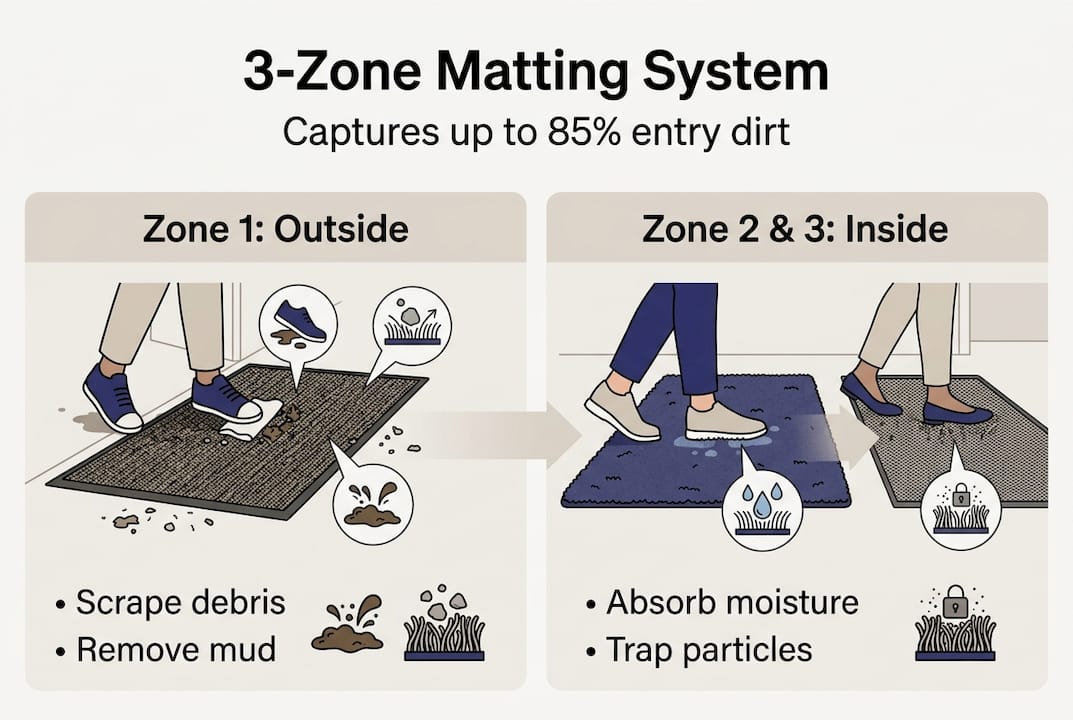
The most effective commercial entrance matting is not one product. It is a system. The three-zone approach divides the entry sequence into distinct functional areas, each targeting a different level of contamination.
Zone 1 sits outside the door. It handles the heaviest load: mud, gravel, standing water, and coarse debris. Rigid scraper mats or heavy-duty rubber grates do this work. Zone 2 is the transition zone just inside the door. It captures finer particles and pulls residual moisture from footwear. Zone 3 extends into the interior corridor and performs final polishing, picking up the last traces of dust and dampness before foot traffic reaches the main floor.
When all three zones are in place and properly sized, the three-zone system captures 85-90% of tracked-in contaminants. That number drops sharply when any zone is missing or undersized.
The financial case is equally clear. Facilities pay an estimated $600 per pound to remove dirt that reaches interior floors, factoring in labor, equipment, and cleaning products. A correctly installed matting system typically pays for itself within 6 to 12 months.
| Benefit | Without matting | With 3-zone matting |
|---|---|---|
| Dirt capture rate | Under 30% | 85-90% |
| Cleaning cost reduction | Baseline | Up to 70% |
| Slip incident risk | High | Significantly reduced |
| Floor surface wear | Accelerated | Extended lifespan |
Beyond cost, proper matting delivers measurable safety outcomes:
- Reduces wet-floor slip incidents at entry points
- Lowers liability exposure from fall-related claims
- Maintains compliant, dry walking surfaces during rain and snow
- Supports OSHA and NFSI (National Floor Safety Institute) surface standards
- Protects hard flooring finishes from abrasive grit
For facilities that also want to reinforce identity at the entry, matting with logo options can serve both functional and branding purposes simultaneously.
“The entry zone is the single highest-impact location for contamination control in any commercial building. Every foot of properly specified matting reduces the cleaning burden on every other floor surface inside.”
Choosing the right entrance mat materials and designs
Material selection determines how well each zone performs its job. Nylon, polypropylene, rubber, and aluminum grates each serve distinct functions and perform best in specific zones and environments.
Nylon is the leading choice for interior high-traffic zones. It offers excellent moisture absorption, strong fiber resilience, and holds color well for branded or logo applications. Polypropylene and PET (recycled polyester) fibers provide strong absorbency at lower price points and work well in Zone 2 and Zone 3 positions. Rubber and nitrile rubber are the standard for outdoor Zone 1 applications. They resist UV degradation, drain water efficiently, and deliver reliable slip resistance on wet surfaces. Aluminum grates and bar-top systems handle the most extreme industrial and high-volume entries, channeling debris and moisture into recessed pits below the walking surface.
| Material | Best zone | Key strength | Limitation |
|---|---|---|---|
| Nylon | Zone 2, Zone 3 | Absorbency, durability | Higher cost |
| Polypropylene/PET | Zone 2, Zone 3 | Value, absorbency | Less resilient |
| Rubber/Nitrile | Zone 1 (outdoor) | Slip resistance, drainage | Minimal absorbency |
| Aluminum grate | Zone 1 (industrial) | Heavy debris, drainage | High installation cost |
Follow this selection process to match products to your facility:
- Identify each zone’s location and exposure (outdoor, covered, interior)
- Estimate daily foot traffic volume and peak hours
- Assess weather conditions: rain, snow, mud, or dry climates
- Determine whether branding or logo display is a priority
- Set a budget that accounts for the full replacement cycle, not just initial purchase
Design options include flush-mount recessed installations, surface-laid mats with beveled edges, and custom-printed logo mats. For facilities focused on first impressions, logo mats for branding combine functional dirt capture with visible brand reinforcement.
Pro Tip: For most commercial facilities, nylon-face mats with rubber backing in Zone 2 and Zone 3 deliver the best balance of performance, appearance, and cost over a 2-year replacement cycle.
Sizing, installation, and maintenance: Getting matting right
Material choices mean little if mats are the wrong size or poorly installed. The best practice is to extend mats to the full door width and a minimum of 10 to 15 feet in depth across all zones. This ensures that at least six to eight steps occur on matted surface, which is the minimum needed for effective decontamination of footwear.
Installation method matters for both safety and performance:
- Recessed installations sit flush with the surrounding floor, eliminating trip hazards and allowing for seamless ADA compliance
- Surface installations use beveled edges (maximum 0.5-inch rise) to meet ADA transition requirements
- All mats must have slip-resistant backing secured to the substrate
- Fire-retardant materials are required in many commercial building codes
- Mats should not overlap or bunch, as this creates immediate trip risk
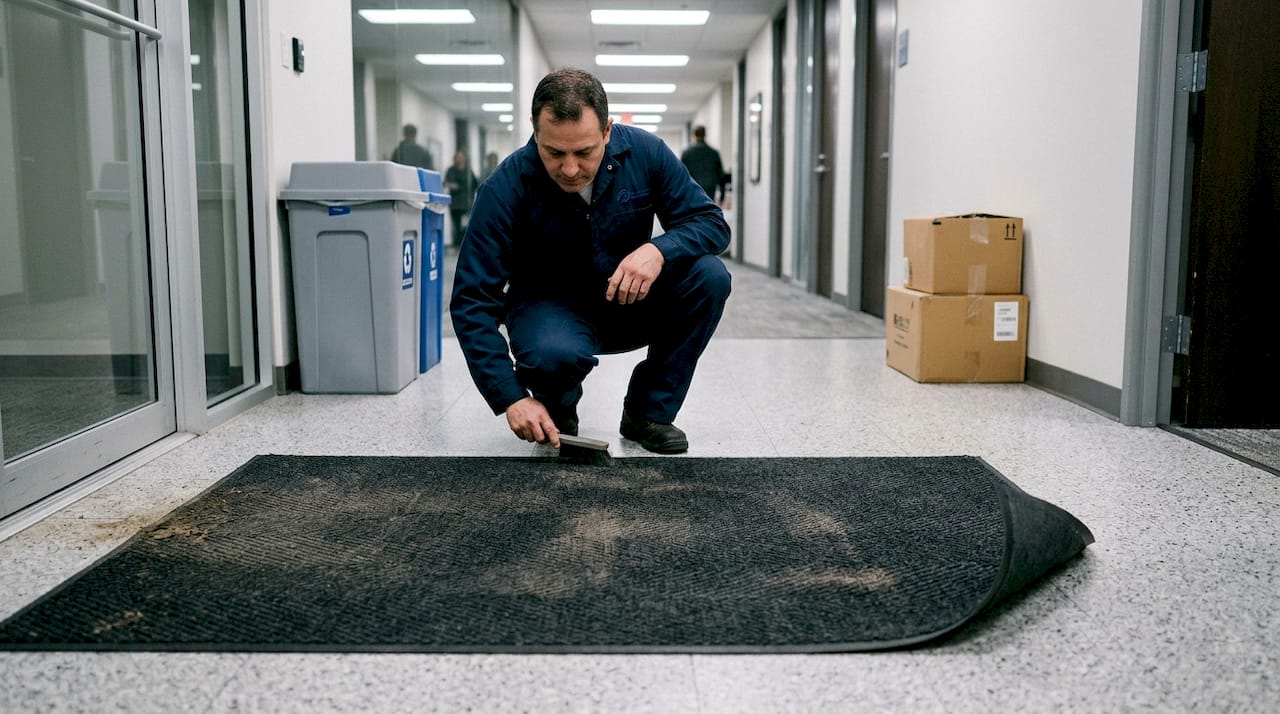
Maintenance is where most facilities lose ROI. A mat that is not cleaned loses its capture capacity quickly. Dirt-saturated fibers stop trapping new particles and begin releasing them back onto foot traffic.
Pro Tip: Schedule extraction cleaning (wet vacuuming or steam extraction) every 30 days for high-traffic entries. Daily dry vacuuming maintains surface capacity between deep cleans.
Key maintenance actions:
- Vacuum daily or after each high-traffic period
- Perform extraction cleaning monthly for heavy-use entries
- Inspect backing and edges weekly for curling, cracking, or separation
- Replace mats showing matted-down fibers, visible wear patterns, or backing failure
Entrance mats last 1-5 years depending on traffic volume, installation quality, and maintenance frequency. Budget for replacement as a recurring line item, not a one-time purchase. For more on installation specifics, custom entry matting tips cover both standard and logo mat configurations.
Maximizing value: ROI, pitfalls, and smart purchasing strategies
Commercial entrance matting is a capital decision, not a supply closet purchase. When you factor in reduced cleaning labor, extended floor finish life, and lower slip-and-fall liability, proper matting reduces cleaning costs by up to 70% and pays for itself in as little as 6 to 12 months.
The primary ROI drivers are:
- Fewer slip-and-fall incidents and associated liability claims
- Reduced labor hours for mopping, scrubbing, and floor refinishing
- Extended lifespan of hard flooring surfaces
- Cleaner visual impression for clients and visitors
Common purchasing mistakes that erode that ROI:
- Buying mats that are too short (under 6 feet total) for the entry sequence
- Using a single thin mat in place of a three-zone system
- Skipping maintenance until mats are visibly destroyed
- Choosing low-cost options without accounting for replacement frequency
- Ignoring outdoor Zone 1 coverage entirely
The buy vs. rent question comes up often. Mat rental services offer predictable costs and automatic replacement, but they limit customization and can cost more over a 3-year horizon than outright purchase. Facilities with strong branding requirements or non-standard entry dimensions almost always benefit from purchasing custom-specified mats.
Pro Tip: Layer your zones and schedule replacement on a staggered cycle. Replace Zone 1 mats more frequently (every 12 to 18 months) and Zone 3 mats less often (every 3 to 4 years), since wear rates differ significantly by position.
For facilities exploring branded entry solutions, logo mat strategies outline how to integrate performance matting with consistent visual identity across multiple locations.
What most guides miss about commercial entrance mats
Most technical guides focus on material specs and zone theory. That is useful, but it misses the operational reality most facility managers face: the biggest failures happen not from choosing the wrong fiber, but from undersizing and under-maintaining what is already there.
The industry has a tendency to promote premium single-mat products as complete solutions. A high-end nylon mat at the door looks good in a spec sheet. But single small mats fail to capture even 30% of tracked-in dirt. That gap between marketing claims and real-world performance is where facilities absorb hidden costs.
Small mats, typically 3 by 5 feet, cover only one or two steps. Most footwear decontamination requires six or more steps on matted surface. The math simply does not work in favor of a single mat, regardless of its quality.
There is also a liability dimension that rarely appears in purchasing guides. An undersized or worn mat that moves, buckles, or fails to control moisture is not just ineffective. It is a documented hazard. Facilities that cannot demonstrate a maintained, properly sized matting system face greater exposure in slip-and-fall litigation.
The practical takeaway: prioritize zone coverage and correct sizing before premium materials. A correctly sized three-zone system using mid-grade materials outperforms a single premium mat every time. For facilities that want to reinforce professionalism at the entry, branding with door mats works best when the underlying system is already sized and positioned correctly.
Solutions for every facility: Choose the right entrance mats
With the core principles in place, the next step is selecting products that match your facility’s traffic volume, weather exposure, and branding requirements. At Mats4U, you will find a full range of commercial entrance mat options built for real-world performance. For facilities that need visible brand presence at the entry, premium custom logo mats deliver high-resolution graphics on durable, high-traffic-rated construction. For properties facing heavy moisture and outdoor exposure, durable WaterHog mats offer proven water and debris control with a bi-level surface that traps and holds contaminants. Free delivery is available on orders over $100, and all products are Made in the USA.
Frequently asked questions
How long do commercial entrance mats typically last?
Entrance mats in high-traffic areas generally last 1-5 years depending on material, usage intensity, and maintenance frequency. High-traffic Zone 1 mats typically need replacement every 12 to 18 months.
What is the recommended size for a commercial entrance mat?
Experts recommend a minimum of 12-18 feet in total length across all zones, covering the full door width, to achieve 85-90% dirt and moisture capture.
How do you maintain commercial entrance mats for longevity?
Regular vacuuming and periodic extraction cleaning extend mat lifespan significantly. Inspect edges and backing weekly and replace mats showing fiber compression or backing failure.
What makes a commercial mat ADA compliant?
ADA-compliant mats feature beveled edges with a maximum 0.5-inch rise for smooth transitions and slip-resistant backing that prevents mat movement under foot traffic.


