


TL;DR:
- Many commercial mats labeled as “heavy duty” degrade quickly when exposed to high traffic, creating safety hazards and increasing costs. Proper evaluation of attributes like chemical resistance, load tolerance, and slip resistance ensures longer-lasting, safer mats tailored to specific facility zones. Staff awareness and maintenance protocols significantly extend mat performance, making quality procurement and informed site management essential for durability and safety.
Facility managers frequently purchase matting rated as “heavy duty” only to find it degraded, curled, or unsafe within a year of installation. The assumption that any commercial mat will survive high-traffic punishment is a costly one. Premature mat failure creates slip hazards, accelerates floor damage, and adds unplanned replacement costs to already tight maintenance budgets. This guide covers what truly defines mat durability, the factors that drive long service life, how to specify the right product for your facility, and the procurement mistakes that derail even well-intentioned purchasing decisions.
Table of Contents
- What defines high durability matting?
- Key factors influencing mat longevity and safety
- Selecting the right high-durability mat for your facility
- Common mistakes and cost pitfalls when ordering durable matting
- The uncomfortable truth about ‘durable’ mats: What procurement teams rarely hear
- Find high-durability matting solutions built for your needs
- Frequently asked questions
Key Takeaways
| Point | Details |
|---|---|
| True durability is proven | High-durability matting performs better over time and under stress if validated by real-world testing and correct specification. |
| Slip resistance matters | Only mats meeting standards like ASTM F2913 ensure safety in high-traffic and contaminated conditions. |
| Right fit means savings | Careful selection for your unique environment cuts costly replacements and minimizes risk. |
| Installation and maintenance count | Quality install and ongoing cleaning routines extend mat life more than materials alone. |
| Mistakes cost more | Choosing the wrong mat or skipping due diligence leads to safety issues and avoidable expense. |
What defines high durability matting?
The word “durable” appears on nearly every commercial mat product page, but the term rarely comes with a clear performance baseline. Durability in the context of matting means sustained performance across repeated use cycles, cleaning events, load impacts, and environmental exposure. It is a measurable outcome, not a marketing label.
Traffic and load conditions are emphasized as essential durability drivers in technical guidance for floor systems, alongside detailing and quality control, rather than relying on materials alone. The same principle applies to matting. A mat made from premium rubber will fail early if the substrate beneath it is uneven, if cleaning chemicals are incompatible with the compound, or if moisture is allowed to pool beneath the backing.
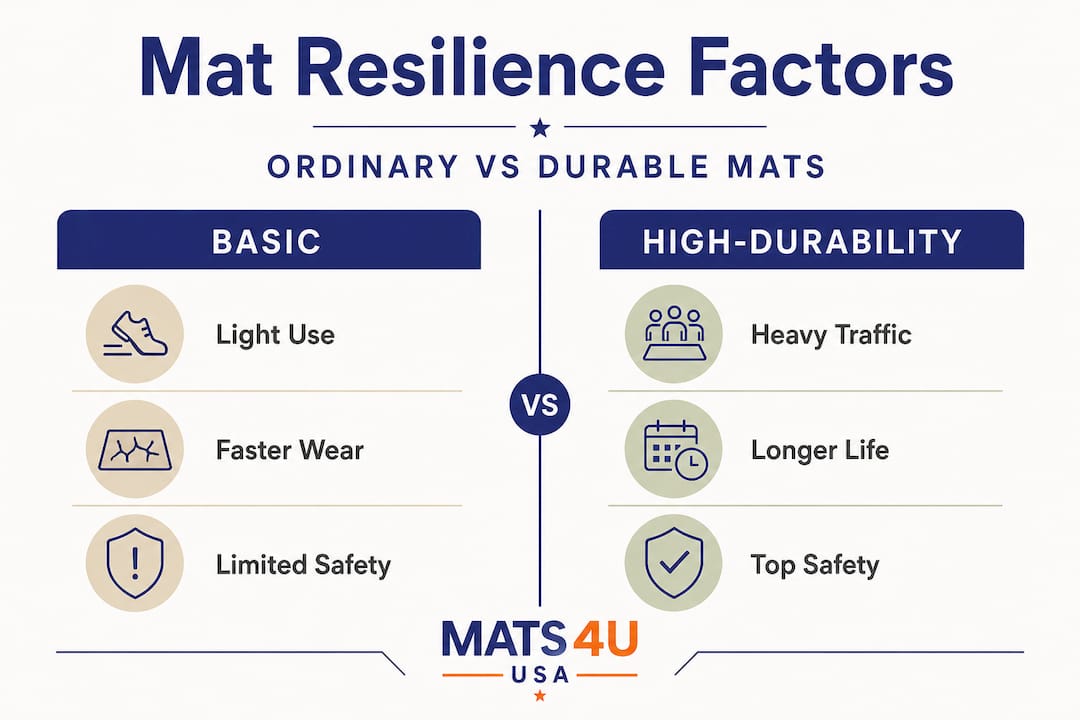
Understanding heavy duty mat features requires looking beyond face fiber weight or rubber thickness. Core attributes that determine real service life include:
| Attribute | Basic commercial mat | High-durability mat |
|---|---|---|
| Face fiber construction | Loop pile, light denier | Heavy-denier, crush-resistant fiber |
| Backing material | Vinyl or light rubber | Nitrile or heavy compound rubber |
| Edge construction | Heat-sealed or bound | Beveled, molded rubber border |
| Chemical resistance | Water only | Resistant to oils, cleaners, solvents |
| Load tolerance | Pedestrian foot traffic | Foot traffic plus cart/forklift loads |
| Cleaning frequency tolerance | Weekly at most | Daily machine washing rated |
Each of these attributes directly affects how long a mat will remain functional and safe. A mat with a lightweight vinyl backing, for example, may separate from the face material after repeated high-temperature washing, which is standard in food processing or healthcare facilities.
Key performance factors to evaluate before purchase:
- Abrasion resistance: Face fiber should retain structure after thousands of foot contacts without matting down permanently.
- Moisture control: Drainage capacity and evaporation rate determine whether the mat remains slip-free in wet conditions.
- Dimensional stability: The mat must hold its flat shape under load and temperature changes. Curling edges are a trip hazard and a maintenance failure.
- Backing adhesion: The bond between face material and backing must withstand mechanical scrubbing and chemical cleaning agents.
- Colorfastness: Facilities with branded or color-coded matting need pigments that resist UV and cleaning agent fading.
The broader matting effectiveness in industry depends heavily on matching these attributes to the actual stressors in each zone of your facility, not on selecting a single “all-purpose” product.
Pro Tip: Before specifying any mat, request a material data sheet from the manufacturer. Confirm chemical compatibility with your cleaning products and verify the mat’s rated load tolerance against actual cart or equipment weights in that area.
Key factors influencing mat longevity and safety
With a working definition of durability established, it is time to understand what actually determines how long a mat will last and whether it continues to deliver safe performance across its service life.
Slip resistance is the safety-critical measure that most procurement teams underweight. ASTM F2913 provides a validated method for measuring the coefficient of friction between footwear and flooring surfaces under contaminated conditions, which is the real scenario in most commercial and industrial environments. A mat that passes dry slip testing but fails when oil, water, or cleaning residue is present is not adequate for the majority of facility applications.
Understanding slip resistance means recognizing that the performance varies based on contaminant type, footwear sole material, and traffic volume. The following table illustrates how these variables interact:
| Variable | Low-risk condition | High-risk condition |
|---|---|---|
| Contaminant | Dry foot traffic | Water, oil, fine particulate |
| Footwear | Rubber-soled safety shoes | Smooth-soled dress shoes |
| Traffic volume | Under 200 passes per day | Over 1,000 passes per day |
| Mat saturation | Below capacity | At or above drainage capacity |
A mat with excellent slip resistance in a dry lobby may perform dangerously in a production area where water and cutting fluids are present. Procurement teams must specify slip resistance relative to the specific contaminants and footwear present in each zone.
Procurement checklist for evaluating mat durability and safety:
- Identify the application zone. Entrance, anti-fatigue station, wet processing area, or heavy equipment lane each has distinct requirements.
- Document the contaminants. List every substance the mat will contact: water, oils, cleaning agents, food debris, or industrial chemicals.
- Measure foot traffic volume. Count average daily passes. Include shift changes and delivery personnel.
- Specify footwear types. Safety boot soles, rubber-soled work shoes, and smooth-soled dress shoes interact with mat surfaces differently.
- Confirm cleaning frequency and method. Daily machine washing, weekly scrubbing, or spot cleaning each requires different material tolerances.
- Check for load beyond foot traffic. Pallet jacks, carts, and forklifts require reinforced backing and high edge stability.
- Review compliance requirements. OSHA standards, local building codes, and industry-specific regulations may mandate specific slip-resistance thresholds.
Incorporating industrial non-slip flooring standards into your procurement criteria ensures that slip resistance is treated as a testable specification rather than a general claim.
Selecting the right high-durability mat for your facility
Understanding the variables influencing mat performance sets the stage for making smart product choices. The selection process should start with a facility zone assessment and end with a documented specification, not the other way around.
Begin with these assessment questions to align mat specifications with your facility’s actual risk profile:
- Which areas generate the most incident reports related to slips, trips, or falls?
- Are there zones where workers stand for extended periods, increasing fatigue and the risk of posture-related injury?
- Does chemical exposure vary by zone, and have you mapped which cleaning products are used in each area?
- What is the floor substrate: concrete, tile, sealed epoxy, or another material? Backing adhesion and drainage behavior vary by substrate.
- Are matting areas subject to outdoor weather exposure, including UV, temperature swings, and moisture infiltration?
Your answers directly drive the product specification. For example, if workers stand at a production station for four or more hours per shift, anti-fatigue mat choices that combine ergonomic cushioning with chemical resistance are the correct starting point, not standard entrance matting.
Features to demand for truly high-durability mats:
- Nitrile rubber compound backing for oil and chemical resistance in industrial zones
- Molded beveled edges to eliminate curl and reduce trip hazard
- Closed-cell foam or rubber cushioning rated for the specific standing load in anti-fatigue applications
- Drainage-capable surface geometry for wet areas, confirmed by drainage rate specification
- Colorfastness ratings for outdoor or UV-exposed entrance positions
- Machine washable construction with temperature ratings that match your cleaning protocol
Step-by-step procurement process for high-durability matting:
- Complete the zone assessment documented above before contacting any supplier.
- Request sample material and test it against your actual cleaning agents for 30 days before finalizing volume orders.
- Ask for a minimum one-year product warranty that covers delamination, dimensional distortion, and fiber degradation under normal use.
- Confirm that the manufacturer or supplier has experience supplying facilities with comparable traffic and contaminant profiles. Reference site data is more reliable than spec sheet claims.
- Build installation requirements into the order. Confirm the floor substrate is clean, dry, and level before matting is deployed.
- Schedule a 90-day post-installation review with both your janitorial and safety teams to identify any early performance issues.
Even durable school facilities face similar selection challenges. Research on durable mats for schools confirms that specification accuracy at procurement time has more impact on long-term safety and cost than any single material choice.
Pro Tip: Include your janitorial team lead and your safety officer in the final product selection decision. Janitorial staff know which mat edges are already curling and which areas have been cleaned around rather than properly maintained. That field knowledge prevents repeat specification errors.
Common mistakes and cost pitfalls when ordering durable matting
Even with the right criteria in hand, many organizations make mistakes during the actual purchase and deployment process. These errors are expensive and often preventable.
The most frequent procurement mistake is selecting matting on unit price alone. A lower-cost mat that requires replacement every eight months costs more than a higher-spec product that lasts three years, even before calculating the labor cost of replacement and the incident risk during mat degradation periods. Traffic load and construction quality details and quality assurance programs directly affect durability outcomes. The same logic applies to matting: shortcuts in specification or installation eliminate the performance advantage of choosing a durable product.
“Selecting matting based on purchase price without accounting for cleaning frequency, load exposure, and substrate conditions is the single most common reason we see repeat mat failures in commercial facilities within the first year of installation.”
Common mistakes to avoid:
- Mismatching mat type to application: Using entrance scraper mats in anti-fatigue zones, or standard loop pile mats in wet industrial areas, guarantees premature failure.
- Skipping substrate preparation: Matting laid on contaminated, wet, or uneven floors will curl, shift, and degrade faster regardless of material quality.
- Ignoring cleaning chemical compatibility: Many rubber and vinyl backings degrade rapidly when exposed to alkaline or solvent-based cleaners. Always verify chemical compatibility before ordering.
- Ordering without knowing actual traffic volumes: Undersizing the mat for foot traffic density accelerates wear. A mat rated for 500 daily passes installed in a 1,500-pass zone will fail in a fraction of its rated lifespan.
- Skipping compliance review: OSHA regulations and local safety codes require specific slip-resistance minimums in wet or chemical exposure zones. Purchasing without checking compliance creates both safety and legal exposure.
- Failing to document installation conditions: If a mat fails and you cannot show installation quality records, warranty claims become difficult to pursue.
Understanding mat lifespan insights before purchasing helps set realistic replacement schedules and budget cycles. Knowing expected service life allows procurement teams to plan proactively rather than reactively.
The uncomfortable truth about ‘durable’ mats: What procurement teams rarely hear
Most mat specification guides focus on checklists. Those are useful. But there is a pattern in recurring mat failures that checklists do not address: the gap between what gets specified on paper and what actually happens on the facility floor.
The majority of premature matting failures do not come from a bad product. They come from an accurate product placed in an inaccurate environment, maintained by a team that was never briefed on its requirements. A nitrile-backed rubber mat rated for chemical exposure will still fail ahead of schedule if the cleaning crew uses a solvent stripper not listed in the compatibility guide, if the mat is folded for storage between shifts, or if it is placed over a drain that creates hydrostatic pressure beneath the backing.
Manufacturers’ durability claims are tested under controlled lab conditions. Lab conditions do not include the 5:00 a.m. cleaning crew who stacks mats to mop under them, or the delivery pallet that gets dragged across the mat edge three times a day. Those realities determine actual service life, not the spec sheet.
Reviewing options like top anti-fatigue mats is a productive starting point, but what extends mat life most consistently is staff buy-in and a documented maintenance protocol that gets followed. Facilities that brief their cleaning teams on mat care, post basic handling instructions near the mat storage area, and conduct quarterly mat inspections get measurably longer service from the same products.
Build a feedback loop. Ask your cleaning staff monthly whether any mats are curling, saturated, or showing edge wear. Ask your safety team whether any mat zones have generated near-miss reports. That information, fed back into your procurement cycle, is more accurate than any manufacturer durability rating.
Find high-durability matting solutions built for your needs
Armed with practical selection strategies and cost-avoidance guidance, the logical next step is connecting with matting products engineered to perform under actual facility conditions. At Mats4U.com, the full range covers entrance matting, anti-fatigue solutions, rubber matting for industrial zones, and specialty options for chemical exposure and wet environments. Products are Made in the USA, tested for commercial performance, and backed by free delivery on orders over $100. Whether you are specifying for a distribution center entrance, a production line station, or a high-traffic corridor in a healthcare facility, the product catalog and selection tools are built to match spec requirements to proven solutions. Contact the team directly for procurement support or volume pricing guidance.
Frequently asked questions
How do I measure mat durability for high-traffic areas?
Durability is best measured by material performance under real load conditions, validated slip testing, and documented longevity data. Traffic and load conditions plus quality control details are more predictive of durability than material claims alone.
What slip-resistance standard should I look for in industrial mats?
Look for compliance with ASTM F2913, which measures the coefficient of friction between footwear and flooring surfaces under contaminated conditions, reflecting real-world slip risk accurately.
Does installation affect mat durability?
Proper installation and ongoing maintenance significantly impact how long a mat performs. Sound floor installation practices and quality assurance programs directly support durability outcomes in floor systems, and the same principle applies to matting deployment.
How often should high-durability matting be replaced?
Replacement timelines depend on traffic volume, contaminant exposure, and maintenance quality. High-durability matting correctly specified and properly maintained can outlast standard commercial mats by two to four years in comparable conditions.
Is there a cost advantage to investing in high-durability mats?
High-durability mats reduce total lifecycle costs by cutting replacement frequency, minimizing slip-related incident claims, and lowering labor costs associated with frequent changeouts. The per-year cost of a durable mat is consistently lower than that of repeated basic mat purchases.


