


TL;DR:
- Industrial mats with advanced materials reduce slips, contamination, and cleaning costs significantly.
- Three-zone entrance systems trap up to 90% of dirt and moisture, cutting cleaning expenses.
- Proper mat selection and regular maintenance ensure safety, durability, and maximum return on investment.
Facility managers often treat floor mats as a low-priority line item. One standard mat at the door, job done. But that assumption carries real cost. Just one pound of dirt can cost facilities up to $600 in removal costs once it reaches interior flooring. Multiply that across a busy commercial building and the numbers become hard to ignore. Research-backed industrial matting systems reduce slips, lower fatigue complaints, and cut cleaning labor significantly. This guide breaks down exactly which solutions work, why they work, and how to apply them in your facility.
Table of Contents
- What qualifies as an industrial matting solution?
- The power of three-zone entrance matting systems
- Slip resistance and safety: How matting prevents accidents
- Performance, ROI, and longevity of industrial matting
- Selecting the right mat: Matching site needs with solutions
- A veteran’s take: Why most facilities miss out on matting ROI
- Where to source reliable industrial matting solutions
- Frequently asked questions
Key Takeaways
| Point | Details |
|---|---|
| Material matters | The right industrial matting material prevents hazards and saves money over years, not just months. |
| Layered systems win | Three-zone setups catch nearly all tracked-in dirt and moisture, radically cutting cleaning costs and risks. |
| Auditing is essential | Quarterly checks and site-specific matting choices are key to long-lasting performance and safety. |
| Buy for ROI | Purchasing custom or heavy-duty mats brings returns far beyond upfront rental savings in hard-use areas. |
| No one-mat-fits-all | Effective matting relies on matching product types to unique facility needs, not on generic solutions. |
What qualifies as an industrial matting solution?
Not every mat on the market is built for industrial demands. A basic commercial mat handles light foot traffic and minor moisture. An industrial matting solution is engineered for sustained punishment: heavy foot traffic, wheeled equipment, chemical spills, oil, and extreme temperature changes.
True industrial mats use advanced material technologies. Polymeric, drainage, SBR/nitrile, and nylon materials can capture up to 99.9% of contaminants and resist workplace hazards. Each material serves a distinct purpose.
| Material | Best use case | Key benefit |
|---|---|---|
| SBR rubber | General industrial floors | Durability, oil resistance |
| Nitrile rubber | Chemical and oil-heavy areas | Chemical resistance |
| Nylon fiber | Entrance and wiper zones | High particulate capture |
| Drainage grid | Wet or fluid-heavy stations | Slip prevention, drainage |
| Polymeric tacky | Cleanrooms, electronics | Contaminant lock-in |
Beyond materials, industrial mats must deliver specific performance features:
- Slip resistance ratings of R11 or higher for wet and oily surfaces
- Drainage grids that move fluid away from foot contact zones
- Chemical and oil resistance to prevent mat breakdown in harsh environments
- ESD (electrostatic discharge) protection for electronics manufacturing areas
- Forklift-rated edges for facilities with wheeled equipment traffic
Standard mats skip most of these features. They break down faster, lose grip, and fail to capture contaminants at the rates industrial settings demand. Explore industrial anti-fatigue mat options and anti-fatigue mat benefits to see how material choice directly affects worker performance. For areas with heavy drainage needs, heavy-duty open-grid options provide a solid starting point.
Pro Tip: Always match your mat to the site-specific risk profile. Foot traffic, wheeled equipment, and chemical exposure each require a different material and construction. A single mat type rarely covers all three.
The power of three-zone entrance matting systems
Single mats at building entrances capture less than 30% of incoming dirt and moisture. A three-zone system changes that equation dramatically. By layering three distinct mat types across 15 to 18 feet of entry space, facilities can trap 85 to 90% of dirt and moisture while cutting cleaning costs by up to 70%.
Here is how each zone functions:
- Zone 1: Scraper mat (exterior) — Removes large debris, mud, and gravel from shoe soles before entry. Typically a heavy rubber or coil mat placed outside the door.
- Zone 2: Wiper/scraper mat (transition) — Captures finer grit and absorbs initial moisture. Often a combination mat with fiber and rubber construction.
- Zone 3: Dryer mat (interior) — Absorbs residual moisture and provides a clean, dry surface for foot traffic entering the building.
| System type | Dirt capture rate | Moisture removal | Cleaning cost impact |
|---|---|---|---|
| Single mat | Under 30% | Minimal | Baseline |
| Three-zone system | 85 to 90% | High | 60 to 70% reduction |
For high-traffic commercial entrances, the return on investment typically arrives within 6 to 12 months. Cleaning labor drops, floor finish lasts longer, and slip incidents at entry points decrease. That $600-per-pound dirt removal cost becomes far less relevant when the mat system is doing its job. Learn more about comfort and safety with industrial mats to see how zoning applies beyond entrance areas. The entrance mat basics guide covers sizing and placement in detail.
To implement a three-zone system effectively:
- Measure your entry corridor and plan for at least 15 feet of mat coverage.
- Select materials matched to your local climate and traffic type.
- Install mats flush with flooring to eliminate trip hazards at edges.
- Schedule cleaning rotations for each zone independently based on soil load.
- Audit placement quarterly and replace mats showing compression or fiber loss.
Slip resistance and safety: How matting prevents accidents
Slip-and-fall incidents are among the most common and costly workplace injuries. Industrial mats are tested against specific standards to quantify their protective performance. Knowing these standards helps you verify that a mat actually delivers the safety level your facility needs.
Key testing metrics include:
- PTV (Pendulum Test Value): A score above 36 indicates low slip risk. Industrial mats achieve PTV scores of 48 to 58 post-installation, moving sites from high risk to low risk overnight.
- R-values: Rated R9 through R13, with R11 and above recommended for wet industrial floors.
- NFSI (National Floor Safety Institute) certification: Confirms a mat meets recognized safety benchmarks for commercial and industrial use.
“Industrial mats rated R11 or higher with PTV scores in the 48 to 58 range have demonstrated up to 100% slip incident reduction in food processing and fire station environments.”
Real-world outcomes back this up. Case studies from industrial warehouses show measurable slip reduction after targeted mat installation. Food processing facilities and fire stations, both high-risk environments with wet and oily surfaces, report near-complete elimination of slip incidents after switching to rated industrial mats.
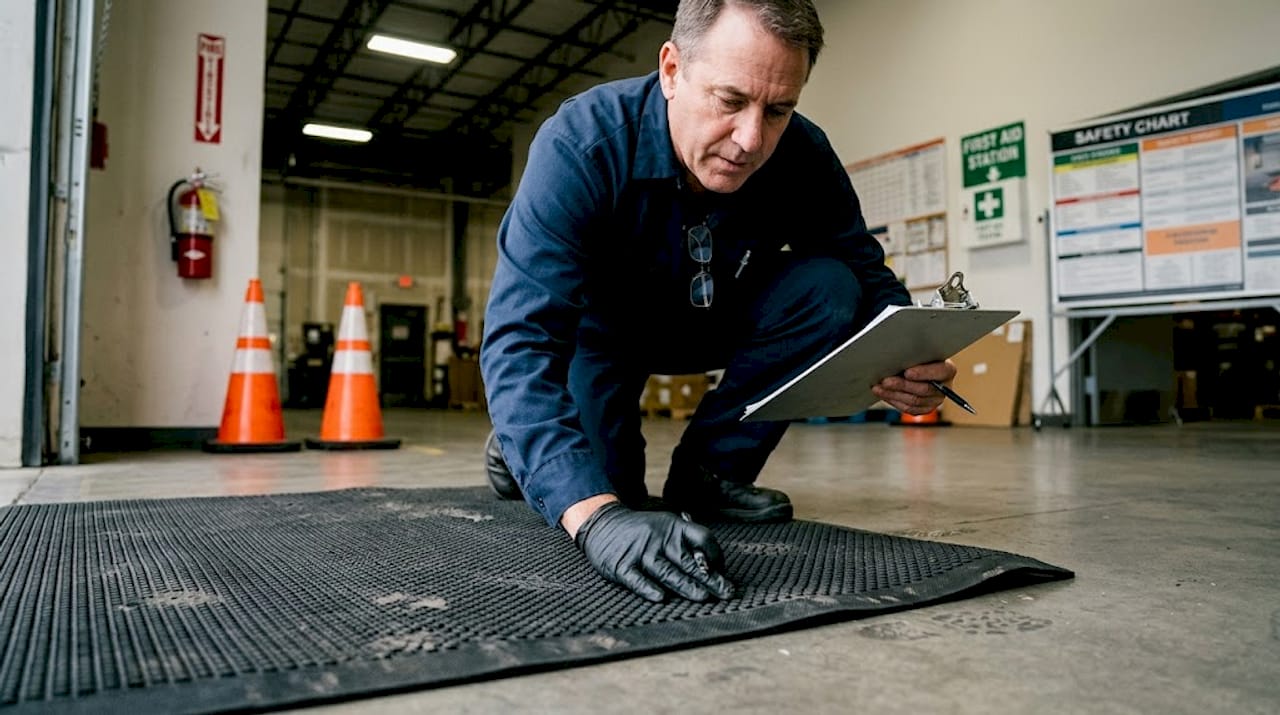
For facilities with drainage requirements, drainage mats for safety provide a solution that removes standing fluid from the foot contact zone entirely.
Pro Tip: Audit slip-resistance performance quarterly. Mats compress and lose surface texture over time, which reduces PTV scores. In oily or wet zones, replace mats on a fixed schedule rather than waiting for visible wear.
Performance, ROI, and longevity of industrial matting
Beyond immediate safety gains, the financial case for industrial matting is well documented. Quality mats reduce fatigue complaints by up to 82% and average an ROI period under 12 months. One food processing facility documented $12,000 in savings within five months of switching to a rated anti-fatigue system.
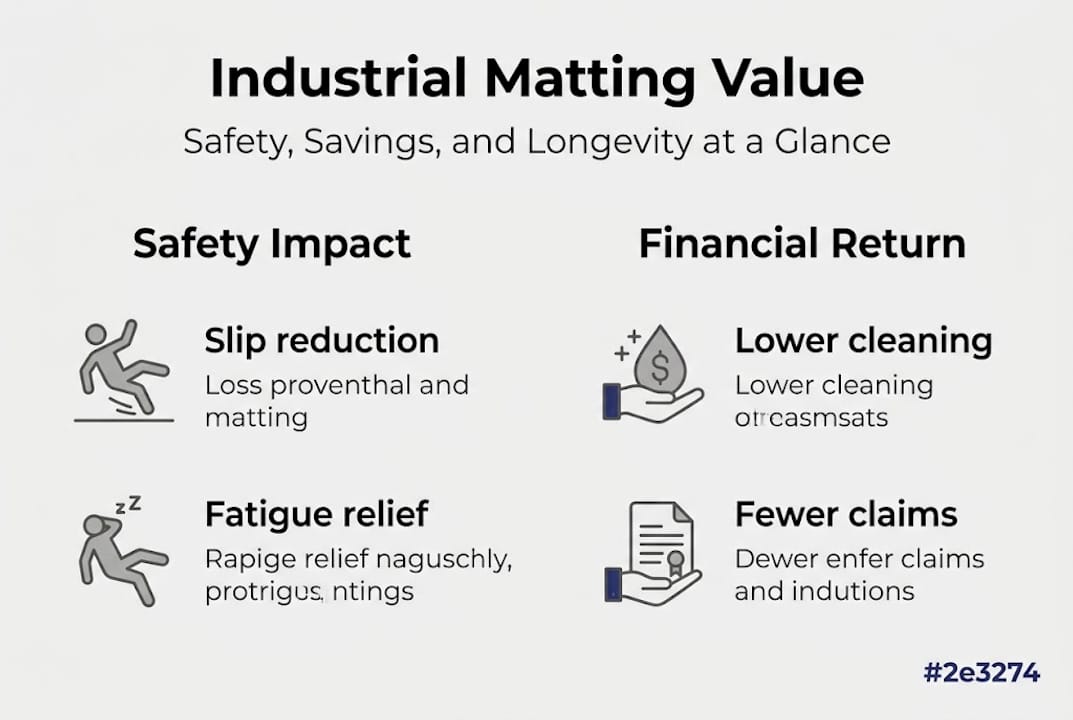
| Sector | Fatigue reduction | Slip reduction | ROI timeline |
|---|---|---|---|
| Food processing | Up to 82% | Up to 100% | Under 12 months |
| Industrial warehouse | 40 to 60% | Up to 80% | 6 to 10 months |
| Commercial office entry | 30 to 50% | 60 to 75% | 8 to 14 months |
Material choice drives lifespan. Mat lifespans range from 3 to 15 years depending on use intensity and material construction. Nitrile and SBR rubber mats last 10 to 15 years in demanding environments. Thin nylon mats in low-duty areas may need replacement every 3 to 5 years.
Another factor worth noting: antimicrobial coatings can inhibit up to 99.9% of microbial growth on mat surfaces, which matters in food production, healthcare, and laboratory settings.
On the rent-versus-buy question, the math favors purchasing for custom-sized or high-duty applications. Rental programs work for temporary setups but rarely deliver cost efficiency over a 12-month period for fixed industrial stations.
To maximize mat lifespan:
- Vacuum or shake out mats on a weekly schedule based on traffic volume.
- Deep-clean rubber and drainage mats monthly with appropriate cleaning agents.
- Rotate mats between high-use and lower-use zones to even out wear.
- Inspect edges and backing for curling, cracking, or adhesion loss quarterly.
- Replace mats before they reach visible breakdown, not after.
See uses for anti-fatigue mats for sector-specific deployment guidance.
Selecting the right mat: Matching site needs with solutions
With performance data and material options clear, the final step is translating that knowledge into a purchasing decision. A structured site assessment prevents the most common and costly mistakes.
Start with a zone-by-zone review of your facility:
- Entry and exit points: Assess foot volume, weather exposure, and surface type beneath the mat.
- High-slip zones: Identify wet, oily, or chemically active areas requiring rated slip resistance.
- Fatigue zones: Flag workstations where staff stand for two or more hours continuously.
- Chemical exposure zones: Note areas with acids, solvents, or oils that degrade standard rubber.
- Wheel traffic zones: Confirm mat edges and backing can handle forklift or cart loads.
- ESD zones: Electronics assembly or sensitive equipment areas need static-dissipative mats.
Testing and matching mats to unique site threats minimizes risk and boosts ROI across all zones.
Avoid these common pitfalls:
- Using thin mats in high-traffic zones — They compress quickly and lose both cushioning and grip.
- Mismatching mat material to chemical exposure — Standard rubber degrades in solvent-heavy environments.
- Renting custom-size mats — Rental programs rarely offer the fit or material specification that custom zones require.
- Skipping edge treatment — Unsecured mat edges create trip hazards that offset any safety gain.
Pro Tip: Run a quarterly audit covering curl, surface compression, coverage gaps, and slip-resistance scores. Document findings and set a replacement trigger based on performance thresholds, not just appearance.
For detailed guidance on choosing industrial anti-fatigue mats, use a selection framework that starts with your most demanding zone and works outward.
A veteran’s take: Why most facilities miss out on matting ROI
After seeing hundreds of facility setups, one pattern stands out. Most budget overruns in matting programs do not come from buying the wrong mat. They come from buying the cheapest option for every zone and then spending far more on cleaning labor, liability claims, and early replacement.
A facility that committed to a full three-zone entrance system after years of single-mat use saw a 40% drop in slip incidents within the first quarter. The mats cost more upfront. The savings in cleaning and incident response covered the cost within eight months.
The unexpected benefits of mats extend beyond the obvious. Reduced absenteeism, lower liability exposure, and longer floor finish life all add up. Most facilities never measure these gains because they are not tracking them.
The most practical lesson: buy for your least forgiving zone first. If your most hazardous area has the right mat, every other zone becomes easier to manage. Quarterly audits and proper material matching outperform any brand name or rental program. The data is consistent. The facilities that commit to a system, not just a product, get the ROI.
Where to source reliable industrial matting solutions
Equipped with practical know-how, your next step is finding industrial mats that check all the right boxes. At Mats4U.com, you will find a full range of tested, durable options built for commercial and industrial demands. The Complete Comfort anti-fatigue mat delivers proven fatigue relief for standing workstations, while the Waterhog Drainable Border Mat handles outdoor entrance zones with reliable drainage and grip. Free delivery applies on orders over $100, and all products are Made in the USA. Whether you need heavy-duty rubber, branded entrance mats, or anti-fatigue solutions, the selection covers the full spectrum of facility requirements.
Frequently asked questions
What materials last longest in industrial environments?
Nitrile and SBR rubber mats offer chemical resistance and lifespans of 10 to 15 years in industrial facilities, making them the top choice for oil, chemical, and heavy-wear areas.
How do I ensure slip resistance is maintained?
Quarterly audits and site-matched mat selection preserve slip resistance over time. Match mat style to wet or oily conditions specific to each zone.
Is renting or buying mats better for industrial use?
Purchasing custom or high-duty mats typically delivers greater ROI than rental programs due to better fit, material specification, and durability over a 12-month period.
Can one mat cover all risks in my facility?
No. Single mats capture under 30% of dirt, compared to 85 to 90% achieved by a properly deployed zoned system. A layered approach is required for full slip, cleanliness, and fatigue coverage.
How much dirt do mats really keep out?
A correctly sized three-zone system can trap up to 24 pounds of dirt per 1,000 visitors every 20 days, keeping that material off interior floors where removal costs escalate quickly.
Recommended
- Industrial Anti Fatigue Mats for Safety & Comfort – Mats4U USA
- A Practical Guide to Choosing Anti Fatigue Industrial Mats That Work – Mats4U USA
- 7 Cost-Effective Matting Solutions for Busy Facilities – Mats4U USA
- Safety Scrape™ Mat - Slip-Resistant, Durable Floor Mat for Tough Environments – Mats4U USA


