


TL;DR:
- High-traffic school areas require durable mats to prevent damage, accidents, and costly replacements.
- Rubber mats offer the best longevity, slip resistance, and safety features for schools.
- Proper placement and maintenance maximize mat lifespan and overall safety and operational efficiency.
Most school administrators assume any floor mat will do the job. That assumption costs money. High-traffic school areas experience up to 4x more damage than standard commercial spaces, and low-quality mats fail fast under that kind of pressure. The result: repeated replacement cycles, higher liability exposure, and floors that degrade faster than they should. This guide breaks down why mat durability matters for schools, which materials and features to prioritize, how to place and maintain mats for maximum value, and what to look for when buying.
Table of Contents
- Why durability matters for school mats
- Top materials for durable school mats
- Key durability features to look for
- Maximizing value: Placement, maintenance, and TCO
- What most schools miss about durable mats
- Find your school’s perfect durable mat solution
- Frequently asked questions
Key Takeaways
| Point | Details |
|---|---|
| Long-term savings | Premium mats cost more up front but reduce maintenance and replacement expenses over a decade. |
| Safety first | Rubber mats with textured surfaces dramatically decrease slips and trips in busy school areas. |
| Choose by area | Match mat materials and thickness to the traffic and conditions of each school zone for best results. |
| Value is more than price | Consider total cost of ownership, including cleaning, liability, and service life—not just initial price. |
Why durability matters for school mats
School buildings are among the most demanding environments for floor coverings. Hundreds or thousands of students move through corridors, entrances, and cafeterias every single day. Wet shoes, heavy backpacks dropped on floors, spilled food, and constant foot traffic all add up. A mat that works fine in a low-traffic office will break down in months under school conditions.
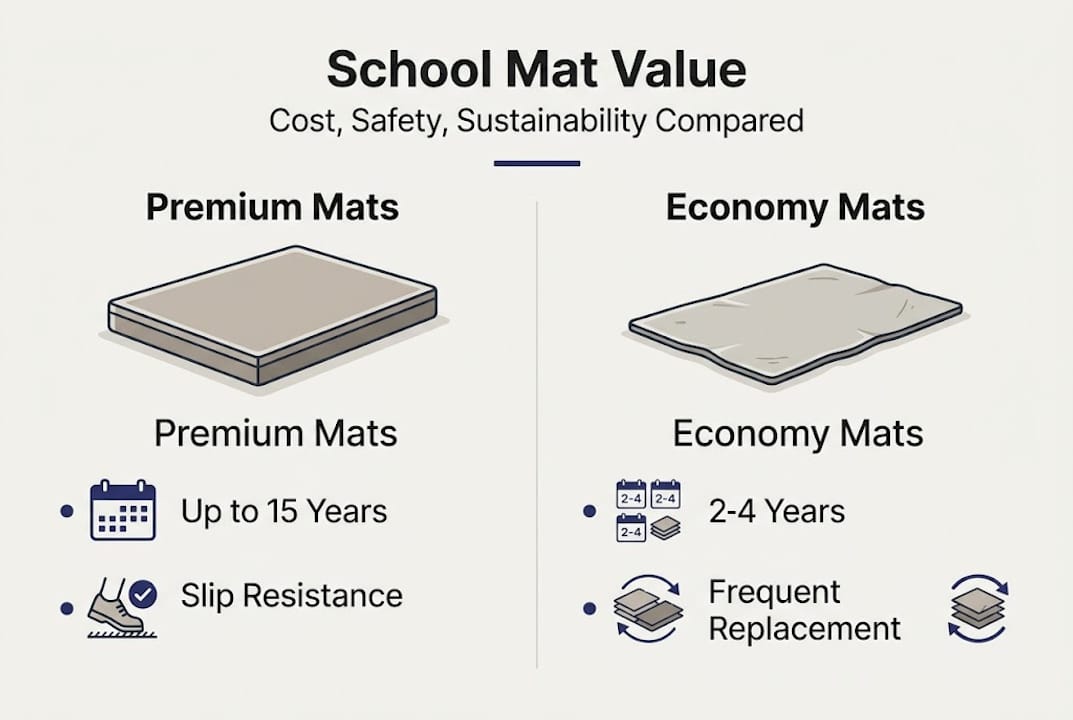
Durable mats absorb impact, trap moisture and debris, and maintain grip even after repeated use. Economy mats, by contrast, compress quickly, lose their surface texture, and start curling at the edges. Curled edges are a direct trip hazard. Compressed surfaces lose slip resistance. Both outcomes increase the risk of student and staff injuries.
The financial case is just as clear. Premium mats last 10 to 15 years. Budget alternatives typically need replacement every 2 to 4 years. Over a 15-year period, a school that buys cheap mats may replace them four or five times, paying more in total than a single premium purchase would have cost. Add in the labor and disruption of each replacement, and the gap widens further.
Core benefits of durable school mats:
- Reduced slip-and-fall incidents and associated liability claims
- Lower floor repair costs from impact and moisture damage
- Fewer mat replacements over the building’s life cycle
- Cleaner indoor air from effective dirt and moisture trapping
- Consistent safety performance across all weather conditions
| Mat type | Avg. lifespan | Approx. cost/sq.ft. over 15 years |
|---|---|---|
| Premium rubber mat | 10 to 15 years | $2.00 to $3.50 |
| Economy/recycled mat | 2 to 4 years | $6.00 to $10.00 |
“Rubber mats provide superior slip resistance and impact absorption, especially in high-traffic zones where floor damage accumulates fastest.”
For a deeper look at construction standards, the heavy-duty mats guide covers load ratings and surface specs in detail. Schools serious about preventing floor accidents should also review slip-resistance ratings before purchasing.
Now that you see why not all mats are created equal, let’s explore the top materials that deliver true durability for schools.
Top materials for durable school mats
Not every mat material performs equally in a school setting. The right choice depends on the specific area, the type of traffic, and the primary hazard you’re managing.
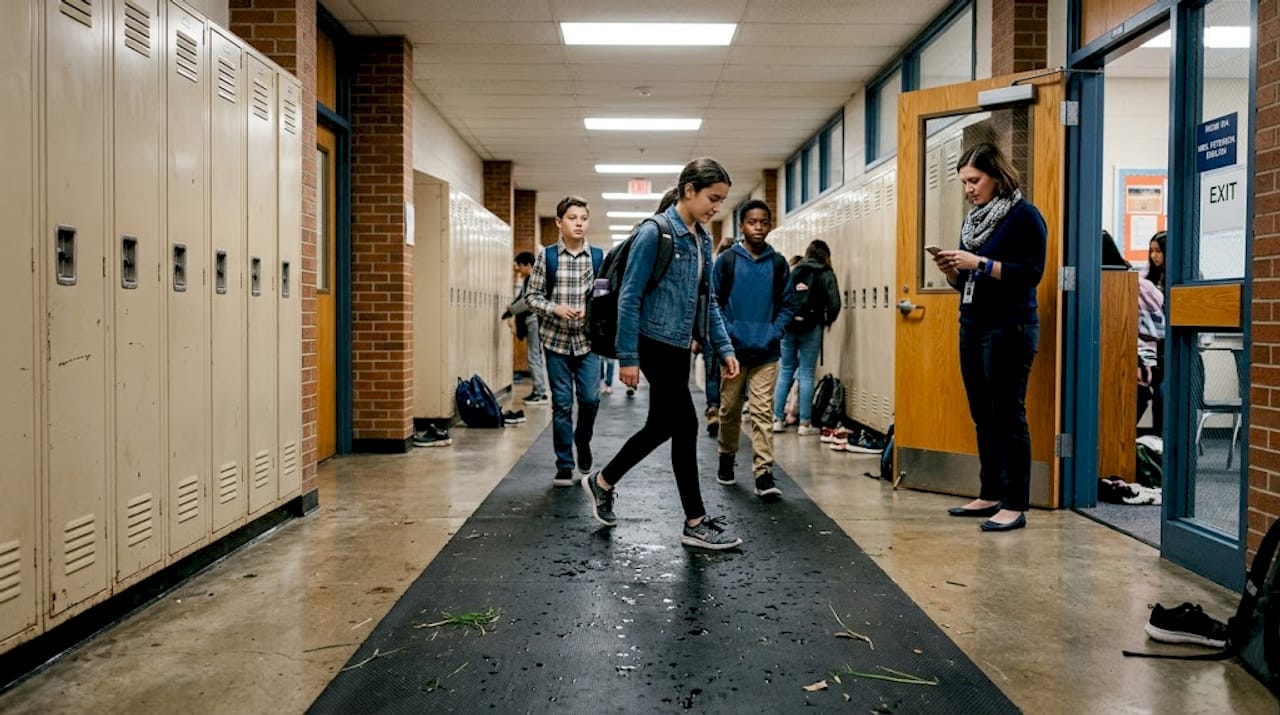
Rubber is the strongest performer for schools. It handles heavy foot traffic without compressing, resists moisture, and maintains surface texture over years of use. Rubber mats work well in corridors, main entrances, gymnasiums, and any area where wet or muddy shoes are common. Rubber mats provide superior slip resistance and impact absorption, especially with textured surfaces and thicknesses of 8mm or more.
Vinyl mats are a lighter-duty option. They’re easier to clean and work in low-traffic areas like administrative offices or small classrooms. However, vinyl compresses faster than rubber, offers less grip on wet surfaces, and typically has a shorter service life. It’s not the right choice for main entrances or gymnasiums.
Blended fiber mats (nylon, polypropylene, or mixed synthetic fibers) excel at trapping dirt and moisture at entry points. They’re softer underfoot and look more polished in front-of-house areas. The limitation is durability: fiber mats wear down faster than rubber under heavy traffic and require more frequent cleaning to stay effective.
| Material | Best use areas | Avg. lifespan | Slip resistance | Durability rating |
|---|---|---|---|---|
| Rubber | Entrances, gyms, corridors | 10 to 15 years | High | Excellent |
| Vinyl | Offices, low-traffic rooms | 4 to 7 years | Medium | Good |
| Blended fiber | Indoor entry points | 3 to 6 years | Medium | Fair |
Pro Tip: When specifying rubber mats for high-traffic school zones, require a minimum 8mm thickness. Thinner mats compress faster and lose grip sooner.
For more on choosing rubber mats by area type, or to review anti-slip mat options with certified grip ratings, both resources provide spec-level detail.
Understanding the materials helps you pick the right mat for every school area. Now, let’s identify the qualities and features that actually determine a mat’s durability.
Key durability features to look for
Material choice is a starting point. The construction details determine whether a mat actually holds up over years of school use. Before approving any purchase, verify these specific features.
Reinforced edges prevent curling and fraying. Beveled or bound edges also eliminate the raised lip that causes trips. This is a non-negotiable feature for any mat placed in a student pathway.
Dense backing keeps the mat flat and stable. A mat that slides or bunches underfoot is more dangerous than no mat at all. Look for rubber or vinyl backing with a textured underside for grip on hard floors.
Textured surface maintains traction even when wet. Smooth-surface mats become slippery the moment moisture is present. Raised patterns or nibs channel water away from the walking surface.
Stain and moisture resistance reduces cleaning frequency and prevents mat degradation from spills, wet shoes, and cleaning chemicals. Premium mats reduce maintenance by 50% or more, slash liability costs, and are built for a service life of 10 to 15 years.
Anti-microbial treatments matter in school settings where hygiene is a priority. Some rubber and fiber mats include built-in treatments that inhibit mold and bacteria growth.
Key questions to verify durability before buying:
- What is the mat’s thickness, and does it meet the 8mm minimum for high-traffic areas?
- Is the slip-resistance rating above PTV 55 (the standard threshold for safe pedestrian surfaces)?
- Does the mat carry ADA compliance or relevant fire safety certifications?
- What warranty does the manufacturer offer, and what does it cover?
- Are samples available for a real-world trial in your specific school environment?
Pro Tip: Request physical samples and place them in your highest-traffic entrance for one to two weeks before committing to a bulk order. Real school foot traffic will reveal edge stability, surface wear, and grip performance faster than any spec sheet.
For a full review of safe flooring features and certified performance standards, that resource covers compliance details. If your school has staff standing areas in kitchens or labs, anti-fatigue mat selection covers wet-surface requirements specifically.
With these features in mind, you’re ready to select mats that fit every major school area. Next, let’s see how to get the most value from your investment.
Maximizing value: Placement, maintenance, and TCO
Buying the right mat is only part of the equation. Where you place it and how you maintain it determines how long it performs and what it actually costs over time.
Placement priorities for school buildings:
- Main entrances and vestibules: highest moisture and debris load, use heavy rubber mats
- Hallway intersections and corridor junctions: constant traffic, prioritize grip and edge stability
- Stairwells and landings: critical safety zones, use non-slip rubber with beveled edges
- Cafeterias and food service areas: spill risk, choose moisture-resistant mats with easy-clean surfaces
- Gymnasiums and locker rooms: high impact and moisture, rubber is the only practical choice
- Administrative offices: lower traffic, fiber or vinyl mats are acceptable
For slip-proof mat guidance specific to each zone type, that resource maps performance specs to location requirements. If you’re deciding between outdoor and indoor mat options for entry vestibules, the comparison there is worth reviewing.
Maintenance routines that extend mat life:
Daily vacuuming or shaking removes loose debris before it embeds in mat fibers or surface texture. Weekly spot cleaning handles spills and stains before they set. Monthly deep cleaning with appropriate solutions (check manufacturer specs) restores surface performance. Rotating mats between high and lower-traffic zones evens out wear.
The total cost of ownership favors premium mats clearly: a 10 to 15 year service life versus 2 to 4 years for cheap recycled mats, with 50% or more in maintenance savings over that period. A school spending $1,500 on premium entrance mats today may avoid $4,000 or more in replacements and floor repairs over the next decade.
Replace mats only when you see visible surface wear, loss of grip, or structural failure at the edges. Don’t replace on a fixed schedule if the mat is still performing. Let performance be the trigger.
You now have practical guidance for getting peak value from your school’s mat investments.
What most schools miss about durable mats
Most purchasing decisions in school facilities are driven by line-item budget constraints. The mat with the lowest unit price wins the bid. That logic is understandable, but it consistently produces the wrong outcome.
Schools that replace cheap mats every 2 to 3 years never realize that a premium mat could outperform for a full decade and cut total cost significantly. The replacement cost is visible. The liability cost from a slip-and-fall incident is not budgeted in advance, but it is real. A single injury claim can exceed the cost of outfitting an entire school with premium mats.
The most overlooked value is not financial. It’s operational. Facility managers who upgrade to heavy-duty mats consistently report fewer maintenance calls, less floor damage, and cleaner buildings with less effort. Staff spend less time managing mat failures and more time on higher-value work.
A cleaner, safer building also affects the learning environment directly. Students and staff notice when facilities are well maintained. That perception matters for school culture and community trust. Durable mats are a small input with a disproportionately large output across safety, cleanliness, and operational efficiency.
The shift required is simple: evaluate mats on total cost and performance over their full service life, not on purchase price alone.
Find your school’s perfect durable mat solution
Upgrading your school’s mats is a direct investment in safety, cleanliness, and long-term cost control. The right mat reduces slip risks, cuts maintenance demands, and outlasts budget alternatives by years.
Mats4U.com carries a full range of school-ready options. For staff workstations and standing areas, anti-fatigue school mats provide sustained comfort and safety. For main entrances and high-traffic corridors, durable entrance mats deliver proven moisture control and grip. For schools that want to reinforce identity at entry points, custom logo mats combine branding with performance. Free delivery on orders over $100 and Made in the USA construction make Mats4U a practical first stop for school purchasing teams.
Frequently asked questions
How long do premium school mats usually last?
Premium rubber school mats typically last 10 to 15 years with proper care, compared to 2 to 4 years for economy alternatives. Consistent maintenance and correct placement extend that service life further.
Can durable mats really reduce slip-and-fall accidents in schools?
Yes. Rubber mats with textured surfaces provide superior slip resistance and impact absorption in school hallways and high-traffic areas, directly lowering incident rates.
What’s the best placement for mats in a school building?
Prioritize main entrances, hallways, stairwells, gymnasiums, and cafeterias. High-traffic school areas experience up to 4x more damage, making those zones the highest-return placement locations.
How do you clean and maintain durable mats in schools?
Regular vacuuming and periodic deep cleaning maintain performance and extend mat life. Premium mats reduce maintenance by 50% or more compared to economy options, making upkeep faster and less costly overall.


