


TL;DR:
- Most “slip-resistant” mats are marketed without considering actual performance variability and conditions. Facility managers should verify testing standards, contamination states, and slider types to ensure mats provide true slip resistance in real-world environments. Regular monitoring and scenario-specific specifications are essential to prevent safety gaps and liability risks.
Walk through any commercial supplier’s catalog and you’ll see “slip-resistant” stamped on nearly every mat product. The label is everywhere, yet the performance gap between products carrying that same label can be enormous. Facility managers and purchasing agents who rely on that single marketing claim without digging deeper are making decisions that leave real safety gaps, real liability exposure, and real injury risk on the floor. This article breaks down exactly what slip resistance means in practice, how it is tested, and how to evaluate specs so you can make procurement decisions that hold up in the real world.
Table of Contents
- Why slip resistance matters in commercial mats
- How slip resistance is measured: Methods and what they mean
- Decoding mat specifications: What to verify before buying
- Matching the mat to your facility: Practical selection considerations
- Why most facility managers misread slip resistance data
- Get proven slip-resistant mats for your facility
- Frequently asked questions
Key Takeaways
| Point | Details |
|---|---|
| Not all slip-resistant mats are equal | Testing method and context mean more than marketing claims for facility safety. |
| Check the test, not just the number | Always confirm which method, contamination, and footwear were used in slip resistance ratings. |
| Match mats to your risk scenarios | Select mats by your actual traffic, environment, and operation, not generic scores. |
| Request test certificates | Ask vendors for detailed test results to ensure true slip resistance for your needs. |
| Review and maintain mats regularly | Even the best slip-resistant mat needs regular inspection to stay effective. |
Why slip resistance matters in commercial mats
Slip resistance is a measurable property that describes how much friction a surface creates between a shoe or bare foot and the mat. In facility management, it is the single most important performance variable for mats placed in high-traffic zones, wet entries, production floors, and locker room corridors. A mat with inadequate slip resistance does not just create an inconvenience. It creates a hazard.
The consequences of poor slip resistance are serious. Slip-and-fall incidents account for a significant share of workplace injuries every year, and commercial facilities bear the legal and financial cost of those incidents. Workers’ compensation claims, OSHA citations, and third-party liability lawsuits are all on the table when a mat fails to perform. Beyond direct costs, there is productivity lost to injured employees, reputational risk, and the management time spent on incident documentation. Investing in floor safety mats that genuinely perform is far less expensive than the alternative.
“The correct slider must be used during pendulum testing. Two commonly used sliders exist: one for shod pedestrians and one for barefoot, and using the wrong one will produce a result that does not reflect actual risk.”
Common misconceptions among commercial buyers include:
- Believing that any mat labeled “slip-resistant” has been independently tested
- Assuming that a higher friction number always means greater safety in every environment
- Thinking that slip resistance is a fixed property that does not change with moisture, contamination, or wear
- Overlooking the difference between test results on dry surfaces versus wet or oily conditions
- Assuming that one mat can serve every zone in a facility equally
These assumptions lead to purchases that look good on paper but underperform in daily use. Understanding the basics of avoiding slippery floor accidents starts with recognizing that “slip-resistant” is a category, not a guarantee.
How slip resistance is measured: Methods and what they mean
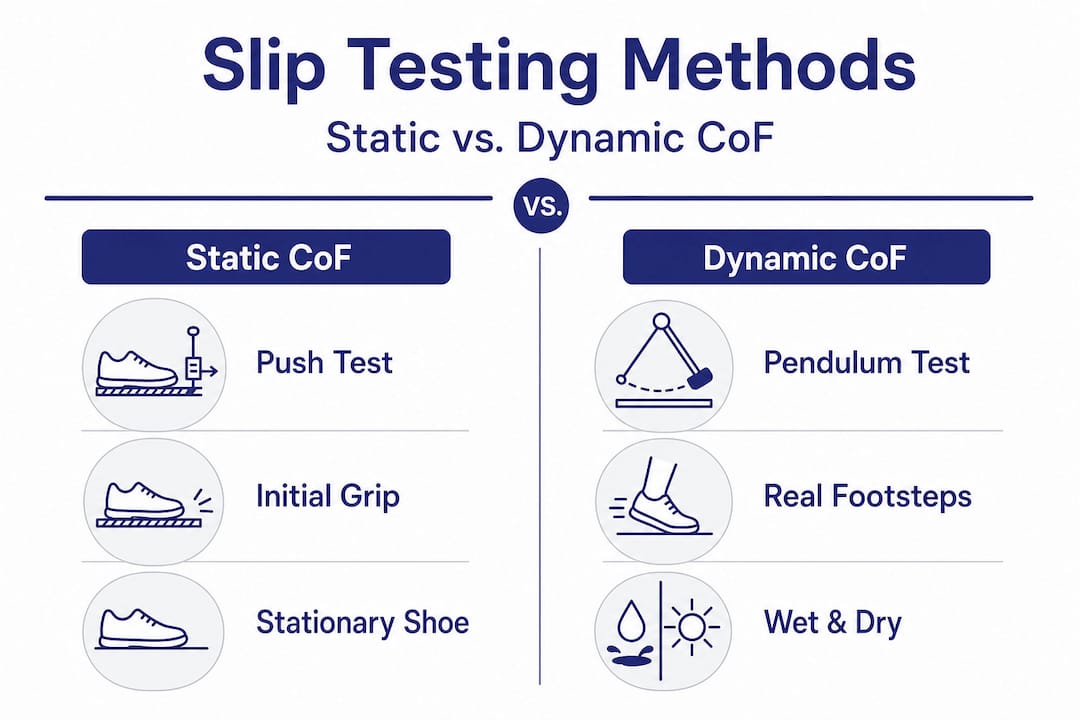
The most widely used method for evaluating slip resistance in mats and floor surfaces is the Pendulum Test. This test measures dynamic coefficient of friction, or dynamic CoF, which reflects the friction generated as a foot moves across a surface. It produces a result called a Pendulum Test Value, or PTV. The PTV is expressed as a number, and higher numbers indicate greater resistance to slipping.
Dynamic CoF is different from static CoF. Static CoF measures the force needed to start moving a stationary object across a surface. Dynamic CoF measures the friction during actual movement. For pedestrian slip risk, dynamic CoF is the more relevant figure because slipping happens during movement, not while standing still.
Where it gets critical for procurement is the slider. Two sliders are used in pendulum testing. One simulates the rubber sole of a shoe (for shod pedestrians), and one simulates bare skin (for barefoot environments like locker rooms, pool decks, or shower areas). A PTV produced with a shod slider cannot be applied to a barefoot zone and vice versa. Using mismatched slider data to evaluate mat safety for the wrong environment is one of the most common and consequential procurement errors you can make.
Contamination conditions also change everything. A mat that scores well on a dry pendulum test may perform significantly worse when wet, oily, or contaminated with cleaning chemicals. Always check what condition the surface was in during testing.
The ASTM guidelines for slip resistance and footwear make it clear: you must specify friction testing method, contamination condition, footwear type (shod vs. barefoot), and whether dynamic or static friction was measured before a number has any actionable meaning.
| Test method | What it measures | Output | When it applies |
|---|---|---|---|
| Pendulum Test (BS EN 16165) | Dynamic CoF during foot movement | PTV (Pendulum Test Value) | High-traffic entries, walkways |
| Shod slider pendulum | Dynamic CoF for footwear surfaces | PTV (shod) | Lobbies, production floors, offices |
| Barefoot slider pendulum | Dynamic CoF for skin-on-surface | PTV (barefoot) | Pool areas, locker rooms, showers |
| Static friction test | Force to initiate movement | Static CoF ratio | Lower relevance for walking surfaces |
| Wet contamination test | Dynamic CoF under wet conditions | PTV (wet) | Entries, kitchens, industrial wet zones |
Pro Tip: When reviewing a mat spec sheet, look for the test standard reference (such as BS EN 16165), the slider type, and whether the test was run dry or wet. If any of those three details are missing, the number is not a valid basis for procurement.
Understanding these methods is what separates reactive purchasing from informed non-slip flooring methods strategy. A single number without context is noise.
Decoding mat specifications: What to verify before buying
A spec sheet is only as useful as the information it actually contains. Most mat supplier data sheets provide a friction value. Fewer provide the full context needed to interpret that value. Your job as a facility manager or purchasing agent is to close that gap before the purchase order is signed.

A higher number on a spec sheet may not predict slip risk for your exact scenario. Two products with identical PTV scores can perform very differently in your facility if they were tested under different conditions, with different sliders, or in a different contamination state than your real-world environment. This is not a minor detail. It is the difference between a mat that prevents incidents and one that creates false confidence.
Here are the steps to verify a mat spec sheet for real slip resistance value:
- Confirm the test standard. Look for a recognized standard such as BS EN 16165 or an ASTM equivalent. If the sheet only says “slip-resistant tested” without citing a standard, ask for the full certificate.
- Identify the slider type. Shod or barefoot? This must match your facility’s pedestrian profile for the zone in question.
- Check the contamination condition. Was the test run dry, wet, or with a specific contaminant? Match this to the real conditions your mat will face.
- Note whether the CoF is dynamic or static. Dynamic is more relevant for walking surfaces.
- Ask for the original test certificate. A marketing sheet summarizes. A test certificate specifies. Always request the certificate.
- Compare the test environment to your site. Laboratory conditions often differ from real-world conditions. Ask the vendor whether field testing has been conducted.
Here is a direct comparison of how spec claims can look similar but differ in substance:
| Mat product | Stated PTV score | Test standard cited | Slider used | Contamination condition |
|---|---|---|---|---|
| Mat A | 45 | BS EN 16165 | Shod (rubber) | Dry |
| Mat B | 42 | Not specified | Not stated | Not stated |
| Mat C | 47 | BS EN 16165 | Barefoot | Wet |
Mat A and Mat C have similar scores, but Mat C’s score is only valid for wet barefoot environments. Using Mat C in a dry shod entry based on its score would be a direct misapplication. Mat B provides no verifiable basis for its claim at all. Without knowing the test method and context, boosting safety with non-slip mats is impossible to achieve consistently.
Pro Tip: Request detailed test certificates from your vendors, not just marketing summaries. A legitimate test certificate will include the lab name, the test date, the standard used, and all test conditions. If a vendor cannot or will not provide one, treat their slip resistance claims as unverified.
A solid anti slip mat guide will reinforce this same principle: context is everything in friction data.
Matching the mat to your facility: Practical selection considerations
Slip resistance ratings only matter if they apply to your actual operating environment. Before selecting any mat, you need to define the physical and operational conditions of each zone where that mat will be deployed.
Key factors to assess for each facility zone include:
- Area function: Is this a dry lobby, a wet kitchen entry, an industrial loading dock, a locker room, or a food processing corridor? Each demands a different performance profile.
- Likely contaminants: Water, oils, cleaning chemicals, food debris, and tracked-in dirt all change a surface’s effective slip resistance. Identify what your mat will encounter daily.
- Footwear types: Heavy industrial boots behave differently on a mat surface than smooth-soled dress shoes or bare feet. The friction interaction changes based on the outsole material.
- Traffic volume and pattern: High-traffic zones wear mats faster, reducing their surface texture and grip over time. High volume also increases the rate of contamination.
- Cleaning regime: Aggressive cleaning chemicals can degrade mat surfaces and alter their friction properties. Confirm that the mat material is compatible with your cleaning protocol.
- Regulatory requirements: Some environments, particularly food production, healthcare, and public-access buildings, have specific slip resistance thresholds that must be met under relevant safety codes.
When engaging vendors, give them scenario-specific information. Rather than asking “what is your most slip-resistant mat,” describe the zone: wet entry, 200 foot traffic events per hour, shod pedestrians in rubber-soled work boots, cleaned with a commercial alkaline degreaser twice daily. That framing forces vendors to match you with a product tested under relevant conditions.
The ASTM guidance on slip resistance and footwear makes this explicit: specify the friction testing method, the contamination condition, and the footwear type before drawing any conclusion from a CoF or PTV score.
Ongoing monitoring matters as much as initial selection. Schedule regular slip resistance checks as part of your facility safety program. Mat surfaces degrade. Cleaning regimes change. Traffic patterns shift. A mat that passed evaluation at installation may not perform the same way 18 months later. This is especially important in zones covered by anti-fatigue mat selection criteria, where worker safety during prolonged standing depends on both cushioning and surface grip.
Review mat performance quarterly. Document findings. Replace or rotate mats when surface degradation is visible or when any slip incident occurs in a matted zone.
Why most facility managers misread slip resistance data
Most procurement errors involving slip resistance are not failures of information access. They are failures of interpretation. Managers receive a spec sheet, see a high PTV score, and move forward. The problem is that a number without context is not data. It is a claim.
The pattern repeats consistently: a facility purchases a mat with an impressive friction rating for a wet entry zone. The test score looks excellent. What the buyer does not check is that the score was produced using a shod slider under dry conditions. The zone in question is a pool entry where barefoot traffic is constant and the surface is always wet. The mat that scored 52 under dry shod conditions may perform at a fraction of that rating under real conditions. Incidents follow. The mat gets blamed. The actual failure was in the procurement process.
The actionable correction is straightforward. Demand scenario-matched specification data from every vendor. Ask directly: what slider was used, under what contamination condition, and for what footwear profile? If a vendor cannot answer those three questions, their slip resistance rating is not a valid basis for your purchase.
Reviewing resources on slip-proof mat safety reinforces the point: effective safety outcomes require matching product performance data to operational reality, not accepting marketing language at face value.
The purchasing agents who get this right treat slip resistance the same way they treat load ratings on shelving or fire ratings on partitions. They require documented, verifiable, scenario-relevant proof. That standard should apply to every mat purchase in your facility program.
Get proven slip-resistant mats for your facility
Mats4U.com supplies commercial and industrial mats built for real facility environments. Products like the WaterHog Max Herringbone Mat are designed for high-traffic entries where wet conditions and heavy foot traffic demand reliable traction. For workstations and standing zones, the Cushion Select Mat combines anti-fatigue support with slip-resistant backing. Browse the full traditional mat range for entrance and transition zone solutions built for commercial use. All orders over $100 qualify for free delivery. Products are Made in the USA, and the full catalog is available online for direct procurement.
Frequently asked questions
What is the best slip resistance rating for entrance mats?
The best rating depends on the specific facility usage, but a PTV of 36 or higher is generally considered safe for most public and workplace environments when tested under relevant conditions.
Are static or dynamic friction tests more important for mats?
Dynamic friction tests better simulate real-world foot movement and are the more reliable indicator of slip safety for pedestrian mat surfaces.
Why can two mats with similar slip resistance scores perform differently?
Scores depend on the test method, slider type, and contamination conditions, so a result that does not match your facility scenario is not a valid predictor of real-world performance.
Is it necessary to request test certificates from mat suppliers?
Yes. A detailed test certificate confirms that friction claims are scenario-specific and verifiable, which is the only reliable basis for procurement decisions.
How often should slip-resistant mats be replaced?
Replace mats when visible surface wear or contamination is present, or immediately following any slip incident in a matted zone, since surface degradation directly reduces effective friction.


