


TL;DR:
- Most purchasing mistakes in commercial floor mats stem from misreading specifications, leading to premature wear and safety issues. Understanding terminology around materials, construction, and slip resistance is essential for selecting durable, effective mats suited to specific environments. Proper knowledge empowers facility managers to make informed decisions, ensuring safety, longevity, and cost efficiency.
Most purchasing mistakes in commercial floor mat procurement come down to one thing: misread specs. A facility manager orders what the label calls a “heavy-duty entrance mat,” and six months later the edges are curling and the backing has migrated three inches toward the door. Understanding floor mat terminology isn’t academic. It directly affects safety, durability, and budget. This guide covers the definitions and specifications that matter most, from material types and construction details to slip resistance ratings, specialty mat categories, and maintenance benchmarks.
Table of Contents
- Key takeaways
- Core floor mat terminology: types, materials, and construction
- Slip resistance terminology and testing standards
- Specialty mat terminology: anti-fatigue, aluminum alloy, and custom mats
- Maintenance and lifecycle terminology
- My take on floor mat terminology in practice
- Mats4u products matched to your mat terminology needs
- FAQ
Key takeaways
| Point | Details |
|---|---|
| Terminology drives purchasing decisions | Misreading mat specs leads to wrong product selection, accelerated wear, and safety risks. |
| Slip resistance ratings are not universal | PTV and SCOF use different testing methods and results are not directly interchangeable across standards. |
| Commercial mats wear faster | High-traffic commercial mats need replacement every 1 to 3 years, unlike residential mats at 2 to 5 years. |
| Anti-fatigue mats serve safety, not just comfort | Proper cushioning and ergonomic construction reduce strain and improve productivity in workplaces with prolonged standing. |
| Specialty mat terms require context | Aluminum alloy frames, pile height, and backing types all have specific meanings that affect product performance in real environments. |
Core floor mat terminology: types, materials, and construction
Floor mat definitions start with type. There are four primary categories you will encounter in commercial and industrial settings.
Entrance mats sit at building thresholds and perform two jobs: scraping debris and absorbing moisture. Anti-fatigue mats are placed in standing work zones, specifically kitchen lines, production floors, and service counters. Safety mats function in wet or chemically exposed areas where slip prevention is the primary requirement. Barrier mats act as containment zones, preventing tracked contaminants like oil, grease, or cleaning agents from spreading across a facility floor.
Common mat materials
Material selection defines how a mat performs over time. Here are the core options and what each term means in practice:
- Rubber: Natural or synthetic rubber backing or surface construction. Rubber-backed mats deliver strong floor grip and resist mat creep, making them the default choice for heavy industrial and food service environments.
- Vinyl: PVC-based construction, often used in anti-fatigue and wet-area mats. More affordable than rubber but less durable under extreme temperature or chemical exposure.
- Coir: Natural coconut fiber material. High abrasion for scraping footwear. Best for covered entryways since it degrades with direct moisture exposure.
- Carpet fiber (nylon, polypropylene, olefin): Woven or tufted face fibers used in entrance and logo mats. Nylon holds color better and resists compression more than olefin, which matters in high-foot-traffic corridors.
- Aluminum alloy: Metal mat frames with insertable surface panels, used in permanent floor-mounted installations.
Construction terms you need to know
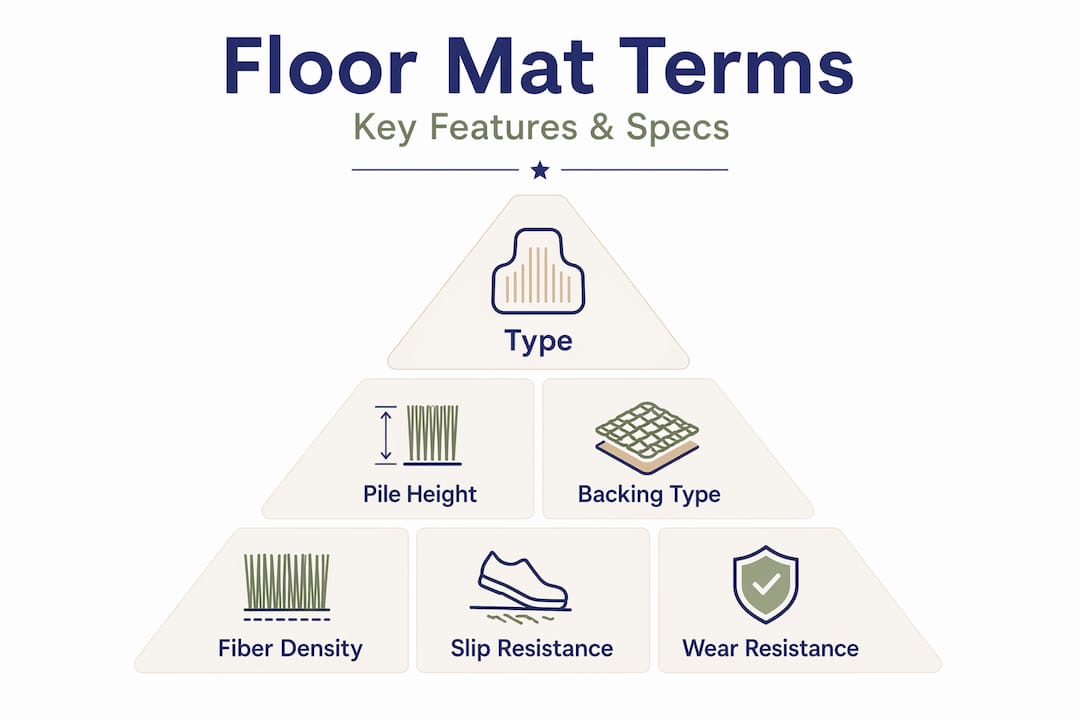
Pile height refers to the length of surface fibers above the mat base. A higher pile traps more moisture but compresses faster under heavy traffic. Most commercial entrance mats use a medium pile of 3/8 to 1/2 inch.
Backing type describes what faces the floor. Rubber nibs, solid rubber sheets, and vinyl cleats are the three main options. Each affects grip, drainage, and floor compatibility differently.
Fiber density is the number of fiber ends per square inch. Higher density means better moisture retention and longer surface life. This is the specification that separates commercial-grade from residential mats. A commercial-grade mat is built to handle thousands of foot passes per day without surface failure. A residential mat is not, regardless of how it is marketed.
Pro Tip: When reviewing mat specifications, request fiber density data alongside pile height. Vendors who cannot provide both numbers are likely offering residential-grade product in a commercial-grade package.
Slip resistance terminology and testing standards
Slip resistance is where floor mat specifications get genuinely technical, and where most facility managers encounter the biggest terminology gaps. Facility managers often underestimate differences in testing standards, which leads to incorrect slip resistance specifications on purchasing documents.
Two primary measurement systems are in active use.
Pendulum Test Value (PTV) is the standard used in the UK and EU under BS EN and DIN frameworks. A spring-loaded pendulum with a rubber slider swings across a wetted test surface. The friction it encounters is expressed as a numerical PTV score. A PTV of 36 or above is classified as low slip risk.
Static Coefficient of Friction (SCOF) is the US standard, governed largely by ASTM test methods. It measures the force needed to initiate movement of a weighted slider across a surface. A value of 0.5 or above is generally considered acceptable for commercial flooring.
Dynamic Coefficient of Friction (DCOF) has largely replaced SCOF in US commercial flooring specifications since it better reflects real walking conditions. DCOF tests friction during motion rather than at rest, which is more accurate for most slip incidents.
The practical point: PTV and SCOF results use different sliders, different parameters, and different scales. You cannot translate a PTV score directly into a SCOF value. Specifying a mat based on a European rating for a US-regulated facility, or vice versa, creates a compliance gap.
| Term | System | Key threshold | Test condition |
|---|---|---|---|
| PTV (Pendulum Test Value) | UK/EU (BS EN, DIN) | 36+ = low slip risk | Wet surface, rubber slider |
| SCOF (Static Coefficient of Friction) | US (ASTM) | 0.5+ = acceptable | Static, controlled load |
| DCOF (Dynamic Coefficient of Friction) | US (current standard) | 0.42+ for wet tile | Moving, weighted slider |
| R-Rating (DIN 51130) | German industrial | R9 to R13 scale | Inclined oil-wet platform |
Slip resistance is also not a single-surface measurement. Effective mat performance depends on surface traction, backing grip, edge design, and installation details working together. A mat with a high DCOF score but poor backing that allows mat creep creates a trip hazard, not a safety solution.
Pro Tip: Always request the specific test method alongside any slip resistance rating. “Slip-resistant” on a product page means nothing without the standard, the score, and the test conditions.
For a technical breakdown of surface patterns and grip features in commercial products, the anti-slip mat guide from Mats4u covers these specifications in detail.
Specialty mat terminology: anti-fatigue, aluminum alloy, and custom mats
Once you move past basic entrance and safety mats, the terminology branches into three distinct specialty categories.
Anti-fatigue mat terms
Anti-fatigue mats are built around ergonomic principles. The core mechanism is controlled instability. The cushioned surface forces micro-movements in the lower legs and feet, which keeps blood circulating and reduces static muscle fatigue. Anti-fatigue mats reduce weariness by encouraging subtle movement and cushioning in workplaces where prolonged standing is standard.
Key terms to know:
- Compression set: The permanent deformation of a mat after sustained weight is applied. A low compression set means the mat returns to its original thickness after use. High compression set means it flattens out and stops functioning as designed.
- Shore hardness: A scale measuring foam or rubber firmness. Anti-fatigue mats typically use a Shore A hardness between 30 and 60. Too soft and the mat provides no postural support. Too firm and it loses cushioning benefit.
- Beveled edge: A sloped perimeter that reduces trip hazard. Standard specification for any anti-fatigue mat in a commercial or industrial environment.
- Grease-resistant surface: A surface coating or material composition that resists contamination from oils and cooking fats. Required in food service and industrial kitchen environments.
For detailed selection guidance on industrial applications, Mats4u’s industrial anti-fatigue mat resource covers these criteria by work environment.
Aluminum alloy floor mat terms
Embedded aluminum alloy mats are flush-mounted into recessed floor frames at building entrances. Common in airports, hospitals, large retail centers, and office lobbies. They eliminate the raised-edge trip hazard of surface-laid mats entirely.
Key terms include recessed frame (the in-floor mounting channel), insert type (the replaceable surface panel, which can be rubber, carpet, or aluminum grating), and load rating (the maximum weight per square foot the frame structure supports). These mats also improve aesthetics by eliminating trip hazards while offering modular, functional surface options that can be swapped out as surfaces wear.
Custom mat terminology
Custom mats introduce a layer of print and design specifications. High-definition logo mats use digital dye-sublimation or UV-cured printing to reproduce brand graphics with sharp color accuracy. Terms to know: bleed area (the printable zone extending to mat edges), color fastness (resistance to fading under foot traffic and UV exposure), and registration accuracy (alignment precision between design file and printed output).
Maintenance and lifecycle terminology
Knowing how long a mat should last, and what degrades it, is as important as knowing what to buy. Commercial mats in high-traffic environments require replacement every 1 to 3 years. Residential mats run 2 to 5 years under normal use. The gap reflects the volume of foot traffic, cleaning frequency, and environmental exposure that commercial environments impose.
| Term | Definition | Why it matters |
|---|---|---|
| Wear resistance | Surface fiber or material durability under foot traffic | Predicts how long the mat surface stays functional |
| Edge curl | Upward warping of mat perimeter over time | Creates trip hazard and indicates backing failure |
| Backing integrity | Condition of the floor-contact layer | Affects grip, mat creep prevention, and floor protection |
| Compression set | Permanent thickness loss in foam or cushioned mats | Indicates loss of anti-fatigue function |
| Pile compaction | Fiber flattening from traffic | Reduces moisture absorption and scraping performance |
Damaged edges and poor backing directly increase trip risk and reduce overall mat durability. Edge curl specifically signals that the backing material has separated or stiffened. Once curling begins, the mat is a liability, not an asset.
Maintenance terminology also covers cleaning methods. Extraction cleaning uses hot water and suction to remove deep-set moisture and debris from carpet-faced mats. Surface vacuuming handles dry debris but does not address contamination in the mat base. Rotation schedules are formal programs for cycling mats between entrances and storage to allow drying and reduce compression in any single mat.
Pro Tip: Schedule formal mat inspections quarterly. Check for edge curl, backing separation, surface pile compaction, and any discoloration that suggests moisture retention. Catching these early extends mat life and prevents safety incidents.
My take on floor mat terminology in practice
I’ve spent years watching facility managers get burned by the same terminology trap. A vendor quotes a slip resistance number, the buyer checks the threshold, and the purchase goes through. Six months later someone slips. What went wrong? The rating was real. The test was just conducted dry, in a lab, with a clean surface. The facility’s entrance gets wet, contaminated with tracked-in salt or oil, and the mat never came close to those conditions during testing.
What I’ve learned is that understanding mat terminology has to go deeper than memorizing definitions. You need to ask what conditions produced the number. Wet or dry? With contamination or without? What standard?
Anti-fatigue mat selection is another area where terminology confusion costs facilities real money. I’ve seen purchasing teams buy the cheapest foam mat that technically meets the “anti-fatigue” description and then wonder why workers still complain about fatigue after four hours of standing. Shore hardness and compression set are the specs that tell you whether a mat will still function in six months. The label “anti-fatigue” tells you almost nothing on its own.
Aluminum alloy modular systems are genuinely underspecified in most facilities. They require upfront investment in framing, but the lifecycle cost per year is lower than surface-laid mats that need annual replacement. The terminology around insert types and load ratings is what allows a facility team to plan that investment correctly rather than discover the wrong insert after installation.
The floor mat definitions in this guide are not just vocabulary. They are the criteria you use to hold vendors accountable and protect your facility from costly errors.
— Werner
Mats4u products matched to your mat terminology needs
Once you have the terminology down, product selection becomes direct. Mats4u carries commercial and industrial mats matched to the specifications covered above, with clear product data to support informed purchasing.
For branding and wayfinding, the Premium HD Custom Floor Mat from Mats4u delivers high-definition print clarity with commercial-grade construction. For entrance performance in heavy-traffic zones, the WaterHog Max Herringbone combines superior moisture retention with a durable rubber backing. For standing work stations, the Comfort Premier anti-fatigue mat provides the cushioning depth and beveled edge profile that commercial environments require. Free delivery applies on orders over $100.
FAQ
What is the difference between SCOF and DCOF?
SCOF measures friction before movement begins, while DCOF measures it during motion. DCOF is now the preferred US standard for commercial flooring because it better reflects walking conditions.
How often should commercial floor mats be replaced?
Commercial floor mats in high-traffic environments typically require replacement every 1 to 3 years, compared to 2 to 5 years for residential mats.
What does pile height mean on a floor mat spec sheet?
Pile height is the length of surface fibers above the mat base. Higher pile captures more moisture but compresses faster under sustained foot traffic, which reduces scraping and absorption performance over time.
What is an embedded aluminum alloy mat?
An embedded aluminum alloy mat is a permanently framed system installed flush into the floor, eliminating raised edges and trip hazards. Inserts are replaceable, making it a long-term installation suited for airports, lobbies, and high-traffic retail environments.
Why does backing type matter when selecting a floor mat?
Backing type determines how well a mat grips the floor and resists migration. Rubber nibs and solid rubber sheets provide stronger grip than vinyl cleats, which matters in wet or high-traffic zones where mat creep creates safety hazards.


