


Selecting the right floor mat size for commercial and industrial facilities is more complex than measuring a doorway. Undersized mats create trip hazards and fail to capture debris effectively, while oversized options waste budget and complicate maintenance. Facility managers must balance coverage needs, traffic patterns, material performance, and safety standards to make informed decisions. This guide provides a practical framework to evaluate mat dimensions based on your environment, usage intensity, and operational requirements, helping you choose solutions that protect workers, extend flooring life, and optimize your investment.
Table of Contents
- Key takeaways
- 1. Essential criteria for selecting mat size
- 2. Overview of common mat types and their sizing standards
- 3. Comparing mat sizes: pros and cons for commercial settings
- 4. Making the right mat size decision for your facility
- Explore quality mats to fit your facility needs
- FAQ
Key Takeaways
| Point | Details |
|---|---|
| Accurate sizing matters | Accurate measurement of door width, traffic patterns, and obstacles guides selecting mats that maximize debris capture and reduce hazards. |
| Door width coverage | Measure 80 to 100 percent of door width and extend the area to cover 2 to 3 steps. |
| Workstation overhang | Size workstation mats to cover the full work area plus a 150 millimeter perimeter overhang to prevent dangerous step offs. |
| Environment matters | High traffic, wet, or oily conditions require larger mats or open grid designs that drain and contain spills within the mat footprint. |
| Survey before purchase | Conduct a site survey during peak activity to observe traffic, identify bottlenecks, obstacles, and irregular shapes that may require custom fabrication. |
1. Essential criteria for selecting mat size
Accurate measurement forms the foundation of effective mat selection. For entrance applications, measure 80-100% of door width and extend length to accommodate 2-3 steps, accounting for door swing radius and adjacent obstacles. This ensures visitors contact the mat surface multiple times, maximizing soil capture before they reach interior flooring. In workstation environments, particularly where employees stand for extended periods, proper sizing requires covering the full work area plus a 150mm perimeter overhang to prevent dangerous step-off incidents.
Environmental factors significantly influence sizing decisions. High-traffic zones demand larger mats to handle increased soil load and extend service intervals between cleaning. Wet or oily conditions require drainage-style mats with open construction, sized generously to contain spills within the mat footprint rather than allowing liquids to spread across surrounding floors. Manufacturing facilities with wheeled cart traffic need mats wide enough to accommodate vehicle paths without edges that catch on wheels or create navigation hazards.
Conducting thorough site surveys before purchasing prevents costly sizing mistakes. Walk through your facility during peak activity periods to observe actual traffic patterns, identify bottlenecks where debris accumulates, and note fixed obstacles like equipment bases or support columns that affect mat placement. Photograph problem areas and measure them carefully, documenting width, length, and any irregular shapes that might require custom fabrication.
Pro Tip: Always add 150mm to your workstation measurements in all directions. This overhang zone catches workers who shift position during tasks, dramatically reducing step-off injuries that occur when employees move from cushioned mat surfaces onto hard concrete unexpectedly.
Undersizing creates multiple problems beyond obvious safety risks. Mats that barely cover doorways force visitors to take short, choppy steps that fail to scrape shoes effectively, allowing dirt to bypass the mat entirely. In industrial settings, undersized anti-fatigue mats cause workers to stand partially on hard floors, negating ergonomic benefits and increasing fatigue complaints. Conversely, oversizing wastes budget on unnecessary material and creates maintenance headaches when custodial staff must work around mats that extend into traffic aisles or block access to equipment.
2. Overview of common mat types and their sizing standards
Anti-fatigue mats designed for industrial standing workstations typically range from 9-22mm thickness with the 150mm overhang standard applied to all sides of the work zone. Thinner profiles suit light-duty applications like retail checkout counters, while thicker constructions provide superior cushioning for heavy manufacturing environments where workers handle tools or operate machinery for full shifts. Size these mats to cover not just where workers currently stand, but where they might move during normal task variations.
Drainage and open-grid mats measure 12-19mm thick and excel in wet processing areas, commercial kitchens, and wash stations. Their perforated design allows liquids to flow through rather than pooling on top, but this requires sizing that accounts for fluid volume. Calculate mat area based on expected spill quantities, ensuring the mat extends beyond splash zones by at least 300mm. In food service applications, size drainage mats to span entire prep stations, providing continuous safe footing even during busy periods when multiple spills occur simultaneously.
| Mat Type | Thickness Range | Typical Coverage | Primary Application |
|---|---|---|---|
| Anti-fatigue | 9-22mm | Workstation plus 150mm overhang | Assembly lines, packing stations, checkout counters |
| Drainage/Open-grid | 12-19mm | Full wet zone plus 300mm border | Commercial kitchens, wash areas, pool decks |
| Entrance scraper | 10-16mm | 80-100% door width, 2-3 step length | Building entries, vestibules, high-traffic doorways |
| Oil-resistant industrial | 12-25mm | Equipment footprint plus spill containment | Machine shops, automotive service, manufacturing floors |
Oil-resistant mats constructed from nitrile rubber compounds require specialized sizing considerations. These mats must contain not just normal standing area but also potential fluid leaks from equipment. Measure the machine base dimensions, then add 450-600mm on all sides to create an effective containment zone. This generous sizing prevents petroleum products from spreading across floors where they create slip hazards and damage standard flooring materials. For applications involving wheeled carts or equipment, verify mat edges include beveled transitions that prevent wheel hang-up.
Pro Tip: In environments with both oily conditions and wheeled traffic, choose mats specifically designed for industrial use rather than general-purpose options. These feature reinforced construction that resists tearing when carts roll on and off repeatedly, and their sizing accounts for dynamic loading patterns that standard mats cannot handle.
Material selection directly impacts sizing effectiveness. Nylon fiber mats excel at moisture absorption in climate-controlled indoor spaces, sized to capture water tracked in during wet weather. Rubber compounds suit outdoor applications and areas exposed to temperature extremes, where sizing must account for material expansion and contraction. Waterhog-style mats combine rubber backing with absorbent fiber surfaces, requiring sizing that balances water retention capacity against practical cleaning limitations. When facilities experience seasonal variation in traffic or weather conditions, consider sizing mats for peak demand periods rather than average conditions.
3. Comparing mat sizes: pros and cons for commercial settings
Small format mats measuring 600x900mm or similar compact dimensions fit limited entry spaces and individual workstations where larger options prove impractical. These work well for single-door residential-style entries, small office doorways, and compact retail checkout positions. However, undersizing risks become pronounced with small mats. Visitors often step over rather than on them, negating their purpose entirely. In workstation applications, small mats force workers to remain stationary in precise positions, reducing natural movement that helps prevent fatigue.
Medium-sized mats spanning 900x1500mm to 1200x1800mm represent the sweet spot for many commercial applications. These dimensions accommodate 2-3 walking steps at building entries, providing adequate soil capture for moderate traffic volumes. At workstations, medium mats allow limited positional shifts while maintaining the critical overhang zone. Cost remains reasonable compared to large-format options, and standard sizes ship quickly without custom fabrication delays. The primary limitation appears when traffic exceeds design capacity, requiring more frequent cleaning and earlier replacement than properly sized alternatives.
| Mat Size Category | Dimensions (typical) | Benefits | Limitations | Best Applications |
|---|---|---|---|---|
| Small | 600x900mm to 900x1200mm | Low cost, fits tight spaces, easy to clean | Limited coverage, higher trip risk, frequent replacement | Single offices, small retail, residential-style entries |
| Medium | 900x1500mm to 1200x1800mm | Balanced cost and coverage, standard availability | May undersize high-traffic areas | Moderate traffic entries, individual workstations, small retail |
| Large | 1200x2400mm and larger | Full coverage, extended service life, improved safety | Higher cost, cleaning complexity, storage challenges | Wide entrances, busy lobbies, large work zones |
| Custom/Bespoke | Any dimensions | Perfect fit, eliminates gaps, addresses irregular shapes | Premium pricing, longer lead times | Irregular spaces, obstacle-filled areas, specialized equipment zones |
Large mats exceeding 1200x2400mm provide comprehensive coverage for wide entrances, busy building lobbies, and expansive workstations. These eliminate gaps where dirt accumulates and reduce trip hazards by ensuring workers never step off cushioned surfaces during normal activities. Service life extends significantly because soil load distributes across greater surface area, slowing wear patterns. The investment pays dividends in reduced replacement frequency and lower injury risk. Challenges include higher upfront costs, increased cleaning difficulty due to weight and size, and storage complications when mats require rotation or seasonal storage.
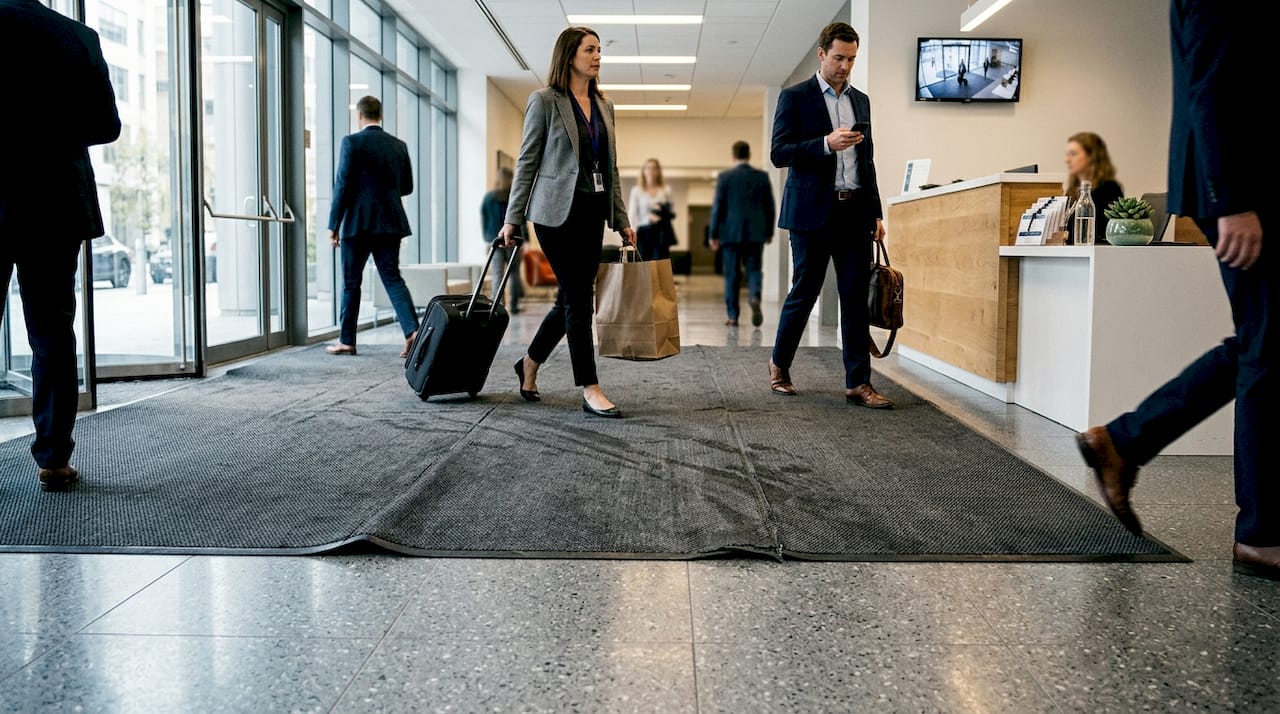
Custom-sized mats reduce hazards in facilities with irregular layouts, permanent obstacles, or specialized equipment configurations. Manufacturing plants often feature support columns, utility connections, and machinery bases that create complex floor plans where standard rectangular mats leave dangerous gaps. Bespoke fabrication ensures continuous coverage that conforms to actual space geometry, eliminating trip points where standard mats end abruptly. While custom options command premium pricing and require longer lead times, they prove essential for facilities prioritizing safety and professional appearance.
The cost-benefit analysis shifts based on traffic intensity and operational priorities. High-volume retail environments justify large or custom mats because reduced cleaning frequency and extended replacement cycles offset higher initial investment. Industrial facilities with significant injury risk find custom sizing essential for liability management, making premium costs negligible compared to potential workers’ compensation claims. Budget-conscious operations serving moderate traffic may optimize costs with medium standard sizes, accepting slightly shorter service life as a reasonable trade-off.
4. Making the right mat size decision for your facility
Implement a systematic decision framework to ensure your mat investment delivers maximum value. Start by conducting a comprehensive environmental assessment. Document traffic volume during peak and off-peak periods, noting whether flow concentrates in narrow paths or disperses across wide areas. Identify environmental challenges like seasonal weather patterns that increase tracked-in moisture, industrial processes generating oil or chemical spills, and temperature extremes affecting material performance. Photograph problem areas showing current flooring damage, accumulated debris, or visible wear patterns that indicate where protection is most critical.
Next, execute precise measurements using this methodology:
- Measure entrance widths at the narrowest point where doors restrict passage, then verify actual traffic patterns spread across the full opening width or concentrate on one side.
- Extend tape measures along primary walking paths to determine how many steps occur in the entry zone, targeting 2-3 full strides for effective soil capture.
- At workstations, outline where employees actually stand during tasks, not just where equipment sits, adding the mandatory 150mm overhang perimeter.
- Map obstacles including door swings, equipment bases, utility connections, and fixed furnishings that affect mat placement.
- Document measurements with photos and sketches showing dimensions and spatial relationships.
Match mat types to your specific conditions using material science principles. Oily industrial environments demand nitrile rubber construction that resists petroleum degradation. Wet areas require open drainage designs that channel liquids away from walking surfaces. High-traffic entries need aggressive scraper surfaces that remove debris effectively. Anti-fatigue applications in industrial settings require cushioned constructions that reduce leg and back strain during extended standing periods.
Pro Tip: Observe workers during actual operations before finalizing mat dimensions. Employees rarely stand perfectly still. They shift weight, rotate to reach tools, and move between adjacent work zones. Extending coverage by 150mm beyond observed movement patterns prevents the step-off injuries that occur when workers unconsciously move from cushioned to hard surfaces.
Consider traffic dynamics and hazard potential in your final sizing decisions. Areas with wheeled carts, pallet jacks, or other mobile equipment need mats wide enough to accommodate vehicle paths plus beveled edges that prevent wheel catch. Facilities with forklift traffic require industrial-grade mats sized for turning radius and load distribution. Emergency exit routes must remain clear, potentially requiring multiple smaller mats rather than single large installations that block egress paths.
Balance competing priorities using this expert framework:
“Effective mat sizing represents the intersection of safety requirements, operational practicality, and budget constraints. Prioritize coverage that eliminates hazards first, then optimize dimensions for cleaning efficiency and cost management. The most expensive mat is one that fails to prevent an injury or requires premature replacement due to inadequate sizing for actual conditions.”
Incorporate employee feedback into final decisions. Workers who use mats daily provide invaluable insights about whether current sizes meet needs or create problems. Maintenance staff understand cleaning challenges and can identify whether proposed sizes will complicate their workflows. Purchasing departments contribute cost analysis showing total ownership expenses beyond initial acquisition. This collaborative approach ensures your mat investment serves all stakeholders effectively while meeting core safety and performance objectives.
Explore quality mats to fit your facility needs
Mats4U offers comprehensive solutions tailored to the sizing challenges discussed throughout this guide. Our premium custom floor mats provide bespoke dimensions that conform to irregular spaces, eliminate gaps around obstacles, and incorporate your branding for professional appearance. These custom options ensure perfect fit in complex environments where standard sizes leave dangerous coverage gaps.
For industrial applications demanding superior fluid management, explore our Action™ industrial mats engineered for oil and coolant absorption. These mats feature sizing optimized for equipment containment zones and the robust construction necessary for wheeled traffic in manufacturing environments. Every product ships with detailed sizing guidance to help you select dimensions that match your specific operational requirements.
Visit Mats4U to browse our complete range of commercial and industrial matting solutions. Our site includes measurement tools, application guides, and expert support to ensure you choose the right size for your facility’s unique needs.
FAQ
How do I measure my workspace to select the best mat size?
Measure width at 80-100% of door openings and extend length to accommodate 2-3 full walking steps. Account for door swing radius, adjacent obstacles, and actual traffic patterns rather than just architectural dimensions. For workstations, outline where employees stand during tasks and add 150mm overhang on all sides.
What mat thickness is recommended for anti-fatigue mats in industrial settings?
Anti-fatigue mat thickness ranges from 9-22mm depending on application intensity and duration. Light-duty retail environments suit 9-12mm profiles, while heavy manufacturing with full-shift standing requires 19-22mm thickness. Thicker constructions provide superior cushioning but cost more and may create trip hazards if edges lack proper beveling.
Are custom-sized mats worth the investment?
Custom mats eliminate hazards in irregular spaces by conforming to actual floor layouts, ensuring continuous coverage around obstacles and in non-rectangular areas. While premium pricing and longer lead times apply, the investment proves worthwhile for facilities prioritizing safety, professional appearance, or complex geometries where standard sizes leave dangerous gaps. Consider premium custom floor mats for spaces with permanent obstacles or specialized equipment configurations.
Which mat materials perform best in oily or wet industrial environments?
Nitrile rubber mats excel in oily conditions because petroleum products cannot degrade the synthetic compound. Drainage and open-grid designs suit wet high-traffic areas by channeling liquids through perforations rather than allowing surface pooling. Match material selection to your specific exposure, sizing generously to contain spills within the mat footprint rather than allowing fluids to spread across surrounding floors.
Recommended
- High-traffic area design tips to boost facility efficiency in 2026 – Mats4U USA
- Best high traffic flooring for commercial spaces 2026 – Mats4U USA
- 7 Key Tips for Using a Floor Mat Size Chart Effectively – Mats4U USA
- Best High Traffic Area Flooring Solutions for Businesses – Mats4U USA
- Vloer opmeten voor tegels: snelle en nauwkeurige aanpak


