


TL;DR:
- Selecting the appropriate flooring depends on each zone’s moisture, traffic, and ergonomic needs within a facility. Floor mats excel at moisture control, slip prevention, and supporting standing workers, while carpets provide acoustic comfort and aesthetic appeal in dry, low-traffic areas. Using a hybrid approach with targeted mats and carpets optimizes safety, maintenance, and operational efficiency.
Choosing between floor mats versus carpets in a commercial facility is not a matter of preference. It is a decision with direct consequences for safety, maintenance costs, employee health, and operational efficiency. Many facility managers treat these two options as interchangeable, deploying carpets where mats are needed or relying on mats without accounting for air quality and acoustic comfort. This article cuts through that confusion with a direct, criteria-based comparison designed to help you select the right flooring solution for each zone in your facility.
Table of Contents
- Key takeaways
- Floor mats versus carpets: core functions and where each belongs
- Maintenance, durability, and lifespan
- Ergonomic and safety impact
- Indoor air quality and environmental factors
- A decision framework for selecting the right flooring option
- My take on where most facilities get this wrong
- Find the right mat solution for your facility with Mats4u
- FAQ
Key takeaways
| Point | Details |
|---|---|
| Mats for entrances and wet zones | Floor mats control moisture and contaminants at entry points where carpets would degrade quickly. |
| Carpets for offices and quiet zones | Carpets deliver sound dampening and thermal comfort in dry, low-traffic interior spaces. |
| Anti-fatigue mats are ergonomic tools | Anti-fatigue mats reduce muscle strain for workers who stand for extended periods, which carpet cannot replicate. |
| Maintenance protocols determine lifespan | Saturated mats must be replaced immediately; carpets require consistent vacuuming to protect indoor air quality. |
| Hybrid placement maximizes results | Combining mats at entries with carpet in interior zones gives you the benefits of both without the drawbacks of either. |
Floor mats versus carpets: core functions and where each belongs
The most common mistake in comparing floor coverings is applying a single solution across an entire facility. Floor mats and carpets are built for different jobs, and understanding those jobs determines where each one earns its place.
Floor mats are designed for targeted, high-intensity duty. Their primary functions include:
- Moisture and dirt capture at entry points: Mats scrape and absorb contaminants from footwear before they spread through the facility.
- Slip prevention on wet or hard surfaces: Rubber-backed mats create traction on tile, concrete, and polished floors that would otherwise become hazards in wet conditions.
- Rapid replacement when compromised: Unlike installed carpet, a saturated or worn mat can be swapped out in minutes without disrupting operations.
- Ergonomic support at standing workstations: Anti-fatigue mats at checkout counters, assembly lines, and kitchen stations reduce physical stress on workers.
Carpets serve a different purpose entirely. They excel in spaces where comfort, aesthetics, and acoustic control matter more than moisture management. Corporate offices, conference rooms, hotel corridors, and retail showrooms all benefit from carpet’s ability to absorb sound, provide underfoot warmth, and project a professional appearance. A carpet’s distributed surface area also provides inherent cushioning that makes extended walking more comfortable than hard flooring.
The key distinction comes down to location within the facility. Entrances, wet production areas, kitchens, loading docks, and standing workstations are mat territory. Interior offices, meeting rooms, and spaces where foot traffic is moderate and dry are where carpets deliver their advantages.
Pro Tip: Map your facility by zone before purchasing any flooring. Label each area by moisture exposure, traffic volume, and employee standing time. This single step will prevent costly mismatches between product and application.
Maintenance, durability, and lifespan
When comparing floor coverings for operational cost, the maintenance burden separates mats and carpets quickly.
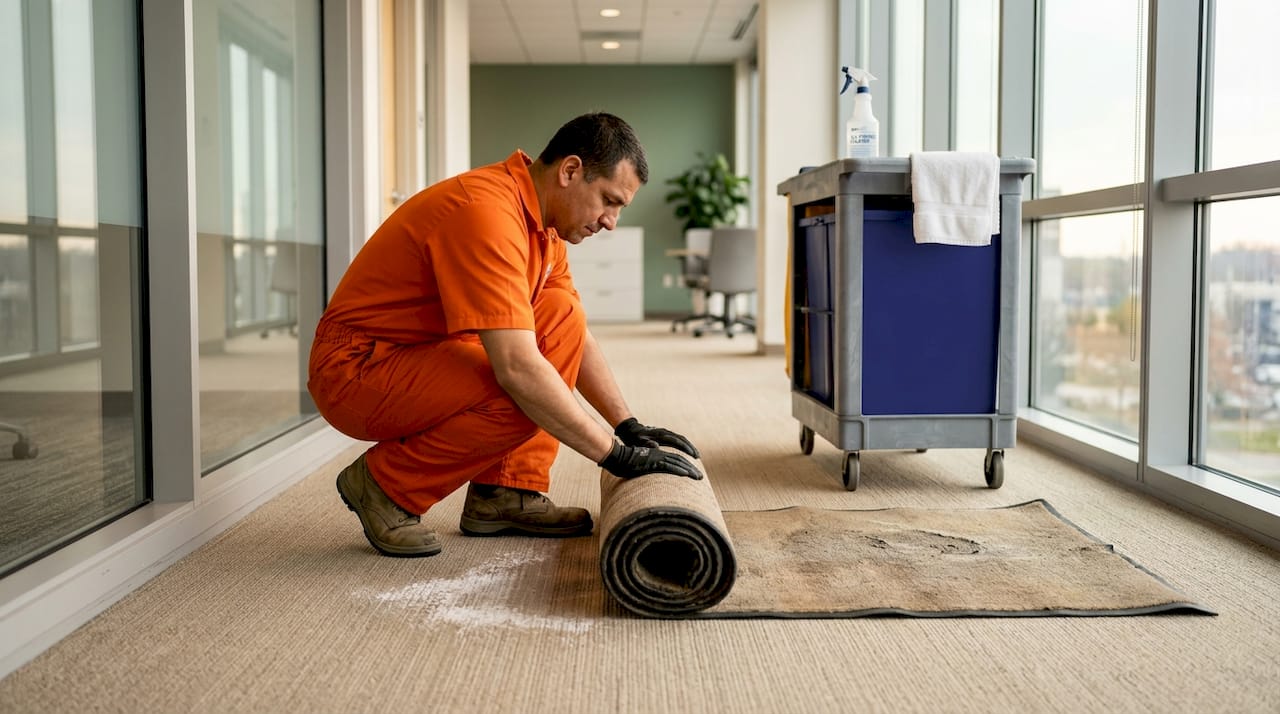
Floor mats in high-traffic areas need active management. ASTM F1637.21 mandates that entrance mats be replaced when saturated to minimize tracked contaminants and slip risk. That is not a recommendation. It is a safety standard. Facilities that ignore wet mat replacement expose themselves to liability and increased incident rates. The upside is that replacing a mat is fast, low-cost, and requires no contractor.
Here is a practical maintenance sequence for commercial mat programs:
- Inspect entrance mats daily during wet weather or high-traffic periods for saturation and soil accumulation.
- Remove and dry the floor surface underneath before reinstalling any mat, as moisture trapped beneath a mat creates slip hazards and mold risk.
- Rotate backup mats so a clean, dry replacement is always available without interrupting coverage.
- Deep clean rubber and nylon mats on a scheduled cycle, typically weekly for heavy-use entrances and bi-weekly for moderate zones.
- Retire mats when edges curl, backing degrades, or scraping surface loses effectiveness. A mat that no longer performs its function is a liability, not an asset.
Carpet maintenance follows a different model. Carpets trap soil over time rather than releasing it with simple removal. Regular vacuuming is non-negotiable for appearance and air quality. Professional extraction cleaning is typically required every 12 to 18 months in commercial settings, depending on traffic.
The durability trade-off is significant. A quality commercial entrance mat can last three to five years under heavy use when properly maintained. A commercial carpet in a high-traffic zone may show visible wear within 18 to 24 months if entrance matting is insufficient. Without proper mat coverage at entries, dirt and abrasive particles get tracked onto carpet fibers, accelerating degradation at an exponential rate. The cost of prematurely replacing carpet in a mid-sized office easily exceeds $20,000. The cost of maintaining an adequate mat program in the same building is a fraction of that.
Ergonomic and safety impact
This is where the comparison between floor mats and carpets gets more nuanced, and where most facility managers leave real value on the table.
| Criterion | Floor mats | Carpets |
|---|---|---|
| Anti-fatigue benefit | High, especially with ergonomic foam or rubber construction | Low to moderate, depending on pile thickness |
| Slip resistance on wet surfaces | High with proper rubber backing | Low. Carpet becomes a hazard when wet |
| Fall cushioning on dry surfaces | Moderate, localized to mat area | Moderate, distributed across surface |
| Customizable for standing zones | Yes, with targeted anti-fatigue products | No, installation is fixed and uniform |
| Maintenance impact on safety | High. Saturated mats must be replaced immediately | Moderate. Worn carpet edges create trip hazards |
Anti-fatigue mats reduce muscle strain and fatigue in workers who stand for prolonged periods, a finding supported by University of Pittsburgh research. The mechanism is specific. Elastic, springy mat materials create micro-movements that support blood flow and prevent the static muscle loading that causes pain and fatigue during long shifts. Carpet does not replicate this effect, regardless of pile depth.
On the safety side, carpet reduces slip risk compared to hard surfaces like laminate or vinyl and cushions falls in dry conditions. However, carpet is not designed for wet or contaminated zones. The moment carpet becomes saturated, it shifts from a safety asset to a liability.
The most effective approach is combining both. Use anti-fatigue mat benefits at standing workstations where muscle strain is a documented concern. Use carpet in dry, walkthrough zones where acoustics and aesthetics matter. This hybrid strategy is standard practice in well-run facilities.
Pro Tip: When selecting anti-fatigue mats, match the material to the environment. Rubber mats resist chemicals and moisture in production areas. PVC foam mats work well in dry office or retail standing zones. Getting this wrong negates the ergonomic benefit entirely.
Indoor air quality and environmental factors
The relationship between flooring choice and indoor air quality is frequently underestimated by facility managers focused primarily on appearance and cost.
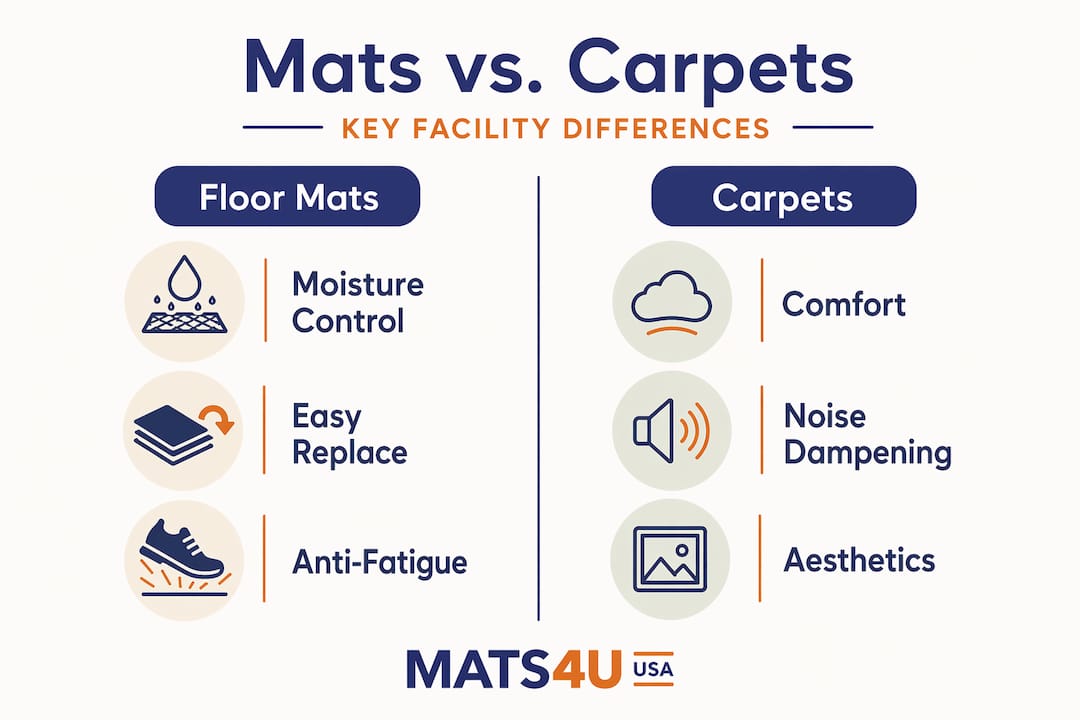
Carpets have a measurable effect on airborne particulates. Modern carpet systems trap dust, pollen, and allergens until removed by vacuuming, which actually reduces airborne particle counts in dry climates compared to hard flooring. This is one of the less obvious advantages of carpets: particles that would recirculate in the air above hard floors settle into carpet fibers and stay there until vacuumed out. The condition is that vacuuming must be consistent and thorough. A carpet that goes unvacuumed for two weeks in a busy office becomes a reservoir rather than a filter.
Key considerations for air quality and environmental impact:
- Mats at entries reduce indoor contamination significantly. ANSI/NFSI standards emphasize that mat length, placement, and maintenance prevent contaminants from migrating beyond the entry zone. A proper entrance mat program can remove up to 80 percent of dirt and moisture before it reaches interior surfaces.
- Humid climates require mat management protocols. In regions with high moisture, mats that remain saturated for extended periods develop mold and bacterial growth underneath. Rotation schedules and rubber-backed designs with drainage features address this directly.
- Carpet in humid zones is a different risk. Wet carpet that dries slowly becomes a source of mold spores and persistent odor that is far more difficult and expensive to remediate than a mat that can simply be removed and cleaned.
- Volatile organic compounds (VOCs) from new carpet installations can temporarily degrade air quality. Specify low-VOC adhesives and allow ventilation time post-installation in occupied facilities.
Facilities in dry climates with controlled HVAC can leverage carpet’s particle-trapping properties effectively. Facilities in coastal, humid, or industrial environments should keep carpet away from any zone with moisture exposure and rely on mat systems that support drainage and fast replacement.
A decision framework for selecting the right flooring option
Use this sequence to evaluate each zone in your facility:
- Assess moisture exposure. Any zone that sees wet footwear, spills, cleaning operations, or outdoor access should use mats, not carpet. There is no workaround that makes carpet viable in consistently wet areas.
- Measure employee standing time. Zones where staff stand for more than 90 minutes per shift are candidates for ergonomic anti-fatigue matting. Review anti-fatigue mat uses by industry to identify applications you may have overlooked.
- Evaluate traffic volume. Entrances, corridors, and production floors with heavy foot traffic wear down carpet rapidly. Mats at these points extend the life of any interior carpet by preventing abrasive soil from being tracked inward.
- Review your maintenance capacity. If your team cannot commit to daily mat inspections in high-use zones, you need to build that rotation into your staffing plan. Slip prevention requires an ongoing maintenance program, not a one-time installation.
- Calculate total cost of ownership. Compare mat replacement and cleaning costs against carpet installation, professional extraction, and early replacement due to wear. In most commercial settings, a well-managed mat program at key zones extends carpet life by 30 to 50 percent.
Pro Tip: Run a pilot zone for 90 days before committing to a facility-wide flooring change. Install mats at a single entry point, track inspection logs, and measure soil accumulation on adjacent carpet. The data from that one zone will justify or redirect your broader investment.
My take on where most facilities get this wrong
In my experience, the biggest failure in commercial flooring decisions is treating mat placement as a one-time task rather than an ongoing program. I have seen facilities invest in quality entrance mats, then let those mats sit saturated for days because no one owns the replacement responsibility. A mat that is soaked through is not just ineffective. It is actively dangerous.
I have also watched facility managers dismiss anti-fatigue matting as a “nice-to-have” for production workers, then face workers’ compensation claims that dwarf the cost of an adequate mat program. The research on ergonomic mat design is clear: these mats reduce fatigue through biomechanical mechanisms, not just comfort perception.
My honest observation is that carpet gets over-applied in facilities where managers prioritize aesthetics over operational reality. Carpet in a corporate lobby looks polished until winter arrives and wet boots track in salt and mud for four months. At that point, the cleaning costs and appearance degradation make the carpet a liability. The right call is a premium entrance mat at the door and carpet beginning at the interior threshold.
The facilities that get this right think of mats and carpets as complementary tools, not competing options. Each has a defined role. Assign them correctly and both perform well.
— Werner
Find the right mat solution for your facility with Mats4u
Mats4u stocks commercial and industrial floor mats built for the exact scenarios covered in this article. For entrances, the WaterHog Max Herringbone Mat delivers proven moisture control and slip resistance under heavy foot traffic. For standing workstations, the Cushion Complete Mat provides ergonomic anti-fatigue support tested for extended shift performance. For facilities that want to combine functionality with branding at entry points, the custom logo floor mat delivers high-definition printing on a commercial-grade base. All products ship free on orders over $100, and the full catalog covers rubber, Berber, Waterhog, and anti-fatigue options across dozens of commercial applications.
FAQ
What is the main difference between floor mats and carpets?
Floor mats are modular, replaceable coverings designed for targeted functions like moisture control, slip prevention, and ergonomic support. Carpets are installed flooring suited to dry interior spaces where acoustics, aesthetics, and distributed comfort are the priorities.
When should a facility choose mats over carpet?
Use floor mats at building entrances, wet areas, standing workstations, and any zone with heavy contamination or moisture exposure. These are conditions where carpet degrades quickly and creates safety and maintenance problems.
How often should commercial entrance mats be replaced or cleaned?
Inspect entrance mats daily during high-use or wet weather periods. ASTM F1637.21 requires replacement when mats are saturated, with the floor surface dried before reinstallation.
Do anti-fatigue mats work better than carpet for standing workers?
Yes. Anti-fatigue mats are designed specifically to promote micro-movements that support circulation and reduce static muscle strain. Carpet provides general cushioning but does not replicate the biomechanical benefit that purpose-built ergonomic mats deliver.
Can floor mats and carpets be used together in the same facility?
Absolutely, and this is the recommended approach for most commercial facilities. Place mats at entrances and standing work zones, then transition to carpet in dry interior areas where sound control and aesthetics matter. This combination extends carpet life and maintains safety standards throughout the building.


