


TL;DR:
- Ergonomic floor mats can reduce lower limb fatigue by up to 54 and back pain by 50 percent.
- Proper mat selection, installation, and ongoing maintenance are essential for maximizing health and safety benefits.
- Integrating ergonomics training and scheduled breaks enhances overall staff well-being and injury prevention.
Most facility managers view floor mats as a slip prevention tool or a way to catch dirt at the door. That assumption leaves significant value on the table. Up to 54% less lower limb fatigue is achievable simply by deploying the right ergonomic matting in the right locations. For commercial and industrial operations where staff stand for extended shifts, that number translates directly into fewer injuries, lower absenteeism, and better output. This guide covers the evidence behind ergonomic matting, how to select the correct type for your environment, proper installation practices, and how to build matting into a broader staff well-being program.
Table of Contents
- Why ergonomic matting matters for staff health and productivity
- Types of ergonomic mats: How to match matting to your environment
- practical installation and safety: preventing trip hazards and maximizing mat performance
- Beyond mats: integrating ergonomic matting into a holistic staff well-being program
- A fresh perspective: what most facility managers miss about ergonomic matting
- Take action: upgrade your workplace with ergonomic matting solutions
- frequently asked questions
Key Takeaways
| Point | Details |
|---|---|
| Evidence-backed benefits | Ergonomic matting reduces worker fatigue and discomfort by up to 54 percent, boosting staff health and productivity. |
| Right mat for the job | Selecting mat types based on the work environment is critical for safety and long-term effectiveness. |
| Install and maintain properly | Regular cleaning and edge treatments prevent trip hazards and extend mat lifespan. |
| Holistic approach works best | Combine matting with training, breaks, and ongoing audits for the best staff well-being outcomes. |
Why ergonomic matting matters for staff health and productivity
Work-related musculoskeletal disorders (MSDs) are one of the top drivers of lost workdays across commercial and industrial facilities. Standing on hard concrete or tile for hours compresses joints, restricts circulation in the legs, and accelerates muscle fatigue. The result is staff who are less alert, less productive, and more prone to errors and injury.
The numbers are clear. Up to 54% lower limb fatigue reduction and a 50% drop in low back pain can be achieved with ergonomic matting in standing work areas. That is not a marginal gain. For a production line or service counter where operators stand six to eight hours daily, those reductions represent a meaningful shift in how staff feel at the end of each shift.
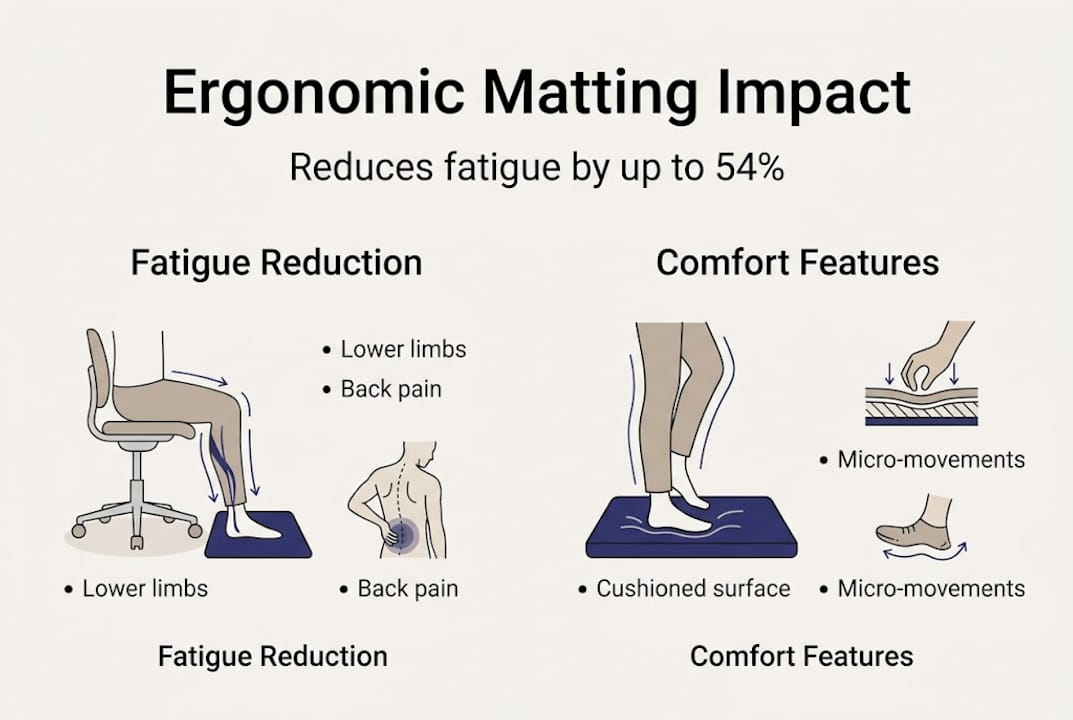
Ergonomic mats work by introducing a cushioned, slightly resilient surface that encourages micro-movements in the legs and feet. These small adjustments keep blood circulating and reduce static muscle loading. Research also documents reductions in foot, leg, and back discomfort across a range of industrial settings, from assembly lines to commercial kitchens.
From a regulatory standpoint, ergonomic benefits overview data supports what safety professionals already observe: ergonomic interventions reduce incident rates. The ergonomics guidelines for worker fatigue reduction point to matting as one of the most cost-effective first steps a facility can take. Additionally, anti-fatigue mat standards under the federal workplace safety framework give facility managers a regulatory basis for prioritizing ergonomic floor solutions.
Key documented benefits of ergonomic matting include:
- Lower limb fatigue reduced by up to 54% in standing work zones
- Low back pain cut by up to 50% for workers in prolonged standing roles
- Joint compression reduced through cushioned, resilient mat surfaces
- Blood circulation improved via subtle weight shifting encouraged by compliant mat materials
- Worker alertness and productivity improved as physical discomfort decreases
“The body was not designed for sustained static standing on hard floors. Any intervention that introduces movement and cushioning directly reduces the physiological strain on workers.”
With the proven benefits in mind, decision-makers must understand the different options available.
Types of ergonomic mats: How to match matting to your environment
Not every mat delivers the same result in every setting. As the evidence-based guide for industrial settings confirms, there is no universal best mat. Environment and specific use conditions define which product actually works.
| Mat type | Best environment | Key advantage | Watch out for |
|---|---|---|---|
| Anti-fatigue mat | General standing workstations, dry areas | Strong cushioning, fatigue reduction | Not suited for oily or wet areas without drainage |
| ESD (ElectroStatic mat) | Electronics assembly, clean rooms | Controls static discharge | Higher cost, requires grounding |
| Anti-fatigue drainage mat | Commercial kitchens, wet processing areas | Combined cushion and drainage | Must be cleaned regularly to prevent bacteria |
| Chemical-resistant mat | Labs, chemical handling zones | Material integrity under spills | Less cushioning than standard anti-fatigue |
| Anti-fatigue comfort mat | Customer service, reception areas | Professional appearance plus comfort | Not rated for heavy industrial use |
Use this numbered process to identify the right mat for each workstation:
- Define the hazard profile. Is the surface typically wet, oily, or dry? Does the area involve static-sensitive equipment?
- Check chemical exposure. Will spills of solvents, cleaners, or food-grade oils contact the mat surface?
- Review weight and pressure loads. Heavy equipment or carts rolling over mats require reinforced materials.
- Consider drainage requirements. Standing water demands drainage mats. Standard foam mats will degrade and become slip hazards.
- Set a cleaning protocol. Select materials compatible with your cleaning agents and sanitation schedule.
For guidance on specific situations, the comparison of comfort vs anti-fatigue mats breaks down the trade-offs clearly. You can also review the guide for choosing industrial mats when working with heavier-duty environments.
Pro tip: A mat that is too soft creates instability. Workers unconsciously tense muscles to stabilize themselves, which increases fatigue rather than reducing it. Target a mat with a firmness rating designed for your shift length and task intensity. The matting recommendations for standing workstations provide useful reference data on compression standards.
Choosing the right type is essential, but quality installation and maintenance are just as crucial for safety.
practical installation and safety: preventing trip hazards and maximizing mat performance
A mat installed incorrectly is a liability, not an asset. Over 40% of trip hazard issues linked to mats trace back to stacking and improper edge treatments. Both are preventable.
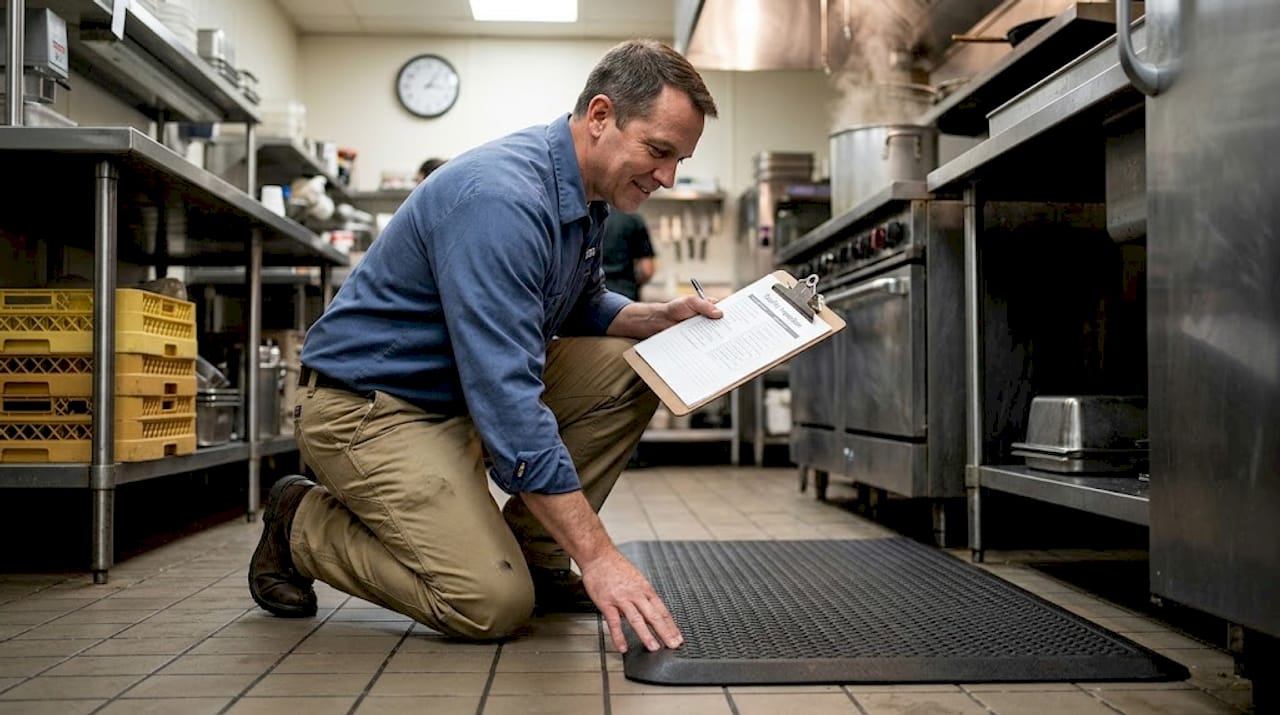
The most critical installation requirement is beveled edges on all four sides of every mat. A beveled edge creates a gradual ramp from the floor surface to the mat, eliminating the abrupt step-up that causes trips. This is especially important in high-traffic corridors and areas where workers carry materials or operate equipment.
Anti-fatigue mat installation best practices also specify that mats must never be stacked. Double-layering creates an unstable, uneven surface that increases both fall risk and fatigue.
Key installation and safety requirements:
- Select mats with verified slip resistance ratings (look for National Floor Safety Institute certification or equivalent R-values)
- Check chemical compatibility before placing mats in areas exposed to oils, cleaners, or solvents
- Never stack mats, regardless of budget pressures or temporary need for added cushioning
- Use mat anchors or adhesive strips in high-traffic areas to prevent shifting
- Size mats to cover the full standing zone, not just the center of a workstation
| Safety feature | Standard requirement | Risk if ignored |
|---|---|---|
| beveled edges | All four sides, minimum 1-inch taper | Trip and fall incidents |
| slip resistance | NSF or R-rating certified | Worker falls on wet surfaces |
| chemical resistance | Match to site-specific spill types | Mat degradation, slip hazard |
| mat anchoring | Required in high-traffic or cart zones | Mat migration, trip hazard |
| edge inspection | Part of quarterly safety audit | Progressive edge curl undetected |
Industrial safety protocols using mats recommend quarterly compression and safety audits. During each audit, check for surface compression loss, edge curl, surface contamination, and any signs of degradation. Replace mats that fail any check. A mat that looks usable but has lost compression provides no ergonomic benefit and increases injury risk.
Pro tip: Build mat audits into your existing quarterly safety walk schedule. Document results by location, and set a maximum mat age based on shift volume and traffic intensity. High-use mats in production environments typically require replacement every 12 to 24 months.
Safe installation is key, but ongoing compliance and staff training boost long-term results.
Beyond mats: integrating ergonomic matting into a holistic staff well-being program
Matting is a high-impact intervention. But it functions best as one element within a structured ergonomics program. As the facility manager’s guide states directly, mats alone are not a complete solution. They must be combined with training and scheduled breaks to deliver lasting results.
Workers need posture training alongside mat deployment. Standing with weight unevenly distributed, locking the knees, or leaning repeatedly in one direction limits the benefit any mat can provide. Short, structured training on how to stand and shift weight correctly costs little and compounds the ergonomic gains from quality matting.
Scheduled movement breaks are equally important. A 2 to 3 minute break every 45 to 60 minutes reduces cumulative fatigue and gives the musculoskeletal system time to recover. These breaks do not require staff to leave their area. Simple stretches or weight shifting exercises are sufficient.
“The goal is not just to reduce discomfort today. It is to prevent the cumulative injury that builds over months and years of suboptimal ergonomic conditions.”
Use this step-by-step plan to build a complete program:
- Complete a workstation audit. Map every standing work area, identify current matting, and note gaps.
- Select and deploy appropriate mats using the type-matching process outlined in the previous section.
- Train staff on posture and movement. Document completion and revisit annually.
- Schedule movement breaks into shift rotations and make them non-negotiable.
- Review workstation layouts. Where staff stand unnecessarily due to layout, redesign the flow.
- Survey staff quarterly. Ask directly about comfort, fatigue, and mat performance.
- Review and adjust. Replace underperforming mats, update training, and iterate.
Reviewing business matting applications across facility types helps you identify which specific workflows benefit most from targeted matting upgrades.
Having understood how matting functions best within a broader initiative, consider a nuanced perspective from industry experience.
A fresh perspective: what most facility managers miss about ergonomic matting
Facility managers often focus on spec sheets and price per square foot when selecting mats. That approach is understandable but consistently produces suboptimal results. The managers who see the greatest long-term gains focus first on workflow fit: how staff actually move, where they stand, and what the floor surface and environment demand.
Short-term cost savings on mat purchases frequently lead to higher long-term costs in injury claims, mat replacements, and productivity losses. A mat that costs 30% less but fails in 8 months rather than 24 is not a saving.
The other common blind spot is treating mat deployment as a one-time task. Staff needs change. Work processes evolve. A mat that was correct for a specific workflow two years ago may not suit the current setup. Regular reviews and staff feedback loops are what separate facilities with sustained ergonomic results from those that cycle through repeated mat problems.
Investing in a culture that values ongoing audits, clean mats, and staff input is what actually drives lasting comfort and safety.
Take action: upgrade your workplace with ergonomic matting solutions
Selecting and deploying the right ergonomic matting does not need to be complex. At mats4u.com, you can browse a full range of commercial and industrial ergonomic solutions built for demanding environments. The Complete comfort mat solution and cushion complete mat are two high-performing options suited to a range of standing workstation needs. Both ship free on orders over $100 and are Made in the USA. If you are ready to prioritize staff comfort and reduce injury risk, start by mapping your standing work zones and matching each one to the right matting category. Our product pages include detailed specifications to support that decision.
frequently asked questions
Are ergonomic mats required by osha for workplaces?
OSHA does not mandate specific mat types, but supports anti-fatigue mats through the general duty clause and ergonomics guidelines aimed at reducing musculoskeletal disorders in the workplace.
How often should ergonomic mats be replaced in a commercial facility?
Conduct quarterly audits for compression and visible wear, and replace any mat showing edge curl, traction loss, or material degradation regardless of age.
What are common mistakes when selecting ergonomic mats?
overly soft mats and mismatched types are the most frequent errors, along with failing to account for the specific chemical, moisture, and traffic conditions of the environment.
Do mats replace the need for breaks or staff training?
No. mats alone are not sufficient and must be paired with structured movement breaks and ergonomic posture training to achieve lasting reductions in worker fatigue and injury risk.
Recommended
- Anti-fatigue mat uses: reduce worker fatigue by 54% – Mats4U USA
- Anti-Fatigue vs Comfort Mats: Facility Manager’s Guide – Mats4U USA
- What Is Anti-Fatigue? 54% Less Worker Fatigue Explained – Mats4U USA
- Comfort Premier™ Mat - Anti-Fatigue, Hygienic, Durable Workplace Solution – Mats4U USA
- Ergonomsko urejena pisarna | Varstvo pri delu in požarna varnost | AGIL d.o.o.
- Office cleaning best practices 2026: 15% productivity boost


